
Blog
It’s official: No EEOC Wellness Rules Will Be in Place by January
It’s official: No new EEOC rules in place by January.
Prior to a few days ago, there were competing visions about whether the EEOC would publish new rules by January, preserving the “safe harbor” to prevent employee lawsuits, or whether they were going to miss the deadline or pass altogether. As is invariably the case when we say the opposite of what a wellness vendor says, our vision won the competition. We predicted this would happen, while Bravo Wellness, taking the lead in attempting to protect the forced-wellness revenue stream, accused us of spreading “rumors, chatter and fiction,” by accurately predicting this would happen.
The EEOC are a smart and committed group. Knowing what they know now about the outcomes and harms of wellness, there is no way they would rush into writing rules forcing employees to submit to unregulated programs run by unlicensed vendors on unwilling subjects, given the tremendous failure rate of these programs, especially following the expose of deceptive and harmful industry practices.
The implications will be covered in Quizzify’s webinar Wednesday May 16: The Pending EEOC Wellness Rule Changes: How Quizzify turns Lemons into Lemonade
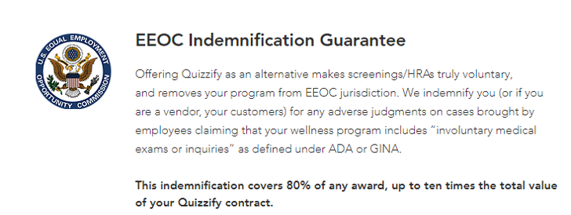
To cut to the chase, the only — and it looks like we do mean only — safe harbor available come January will be Quizzify’s. Otherwise, if you have a “pry, poke and prod” program with high penalties or incentives, you will be open to employee lawsuits because there will be no new rules by then.
The only thing the EEOC will have by January is the Notice of Proposed Rulemaking. It will then take a while after that before the rules are actually proposed, and then commented upon, and then implemented.
Or, you could solve everything, right now, by offering Quizzify’s employee health education curriculum side by side with your existing wellness program. You’ve taken health risk assessments. Now play some Quizzify questions right on the home page. How can an employee learn more from the former than the latter? (Plus as noted, advice on HRAs is often if not usually wrong.)
Register at the link above for more information.
Share this:

What are the 2019 consequences for employees who decline “pry, poke and prod” this summer or fall?
Tune in to Quizzify’s Wednesday webinar, The Pending EEOC Wellness Rule Changes: How Quizzify turns Lemons into Lemonade, for the shocking conclusion.
Meanwhile, don’t believe a word your wellness vendor says…
Share this:


Wellness trade association (HERO) throws itself under the bus
In wellness, there is a saying that you don’t have to challenge the data to invalidate it. You merely have to read the data. It will invalidate itself.
Now that adage can be extended to cover the May “position paper” published by the Health Enhancement Research Organization (HERO). HERO manages to invalidate its own position even though they didn’t actually take a position in this “position paper” to invalidate. They didn’t even present any data…and yet their data was wrong.
All they said was “critically examine research.” Then they provided four paragraphs which showed why doing precisely that invalidates everything they’ve ever published. See for yourself with each paragraph header.

I agree totally — except with the grammar, English being right up there with arithmetic, logic, statistics, and ethics as being courses that HERO’s staff have struggled with. There has not been a single study in the last five years showing wellness saves money. Sometimes, the studies say explicitly that wellness failed, as the National Bureau of Economic Research did, with Medicare close behind. Or Pepsico. Or the state of Connecticut, which, having thrown away millions on inappropriate screenings and doctor visits, declared that losing money was “a good thing.”
Other times, you have to actually read the study to realize that wellness loses money, as in every Koop Award-winning example in the last six years through 2016, like this one and this one and this one and this one and this one and this one. Why not 2017? Because in 2017, they couldn’t even find a study that pretended to save money.
HERO has painted itself into a corner here too, because if a study ever does come out that alleges wellness saves money, critics would simply note that it is important to be skeptical of a claim from a single study refuting all the others. Apparently Prof. Baicker is working on a new paper, having found the arguably the most stable genius vendor in the wellness industry to support what are likely to be claims of savings high enough to support her own previous claims of savings, but low enough so they won’t immediately self-invalidate upon exposure to sunlight. And let us not forget that her original conclusions were publicly invalidated, by name, by her own subordinate. Is this is a great country or what?

The HERO position paper complains that:
Media criticism is sometimes based on programs that are not evidence-based, are poorly implemented, or are incorporated into unsupportive environments.
Hmm… so every time a study comes out showing wellness loses money, it’s because the program was done badly? This list of losers apparently includes the aforementioned Pepsico, whose program was so bad they won two Koop Awards.
During my debate with Ron Goetzel, a number of questions from the audience complained that their own company’s wellness program was horrible. Ron’s stock response: your company needs a better program. He reserved particular animus for the Penn State program, which he himself decried as “horrible,” even though he was the prime architect. In another instance he blamed the questioner for being a bad employee.
Since employees dislike being pried, poked and prodded, “unsupportive environments” would include every company, according to WillisTowersWatson. That means the only companies with “best practice” programs would be wellness vendors themselves, like Vitality Group, where, as a wellness vendor, they curated and implemented only the finest wellness interventions available to mankind. Oh, wait a sec, I goofed. That program failed miserably. Shame on their own bad employees!
Vitality Group is in good company. As Mr. Goetzel says, thousands of programs are done badly while only 100 have succeeded.
“Best practices” might include adhering to US Preventive Services Task Force guidelines, not demonizing social drinking, avoiding harms to employees with eating disorders, and not telling people to do stupid things. I’d settle for a program that does any one of those things.

How much time do they need? 3 years? 6 years? They need more? Sure — here is 14 years‘ worth of results for the entire US, showing virtually nothing has happened. The “wellness-exposed” and “wellness-non-exposed” <65 populations are virtually coincident, with only Medicare — where, by definition, there is no workplace wellness — showing a little improvement. It’s all spelled out here.

This paragraph is supposed to be a subtle diss of the NBER paper, which in the 4 months subsequent to publication, the very stable geniuses at HERO have not mentioned by name to avoid drawing attention to it due to its obvious quality and validity. (Welcome to my world.) True enough that the NBER paper covered only one year, though the authors added there was absolutely nothing “trending towards savings” to suggest that the second year would be any different.
The irony of course is that almost every one of those Koop Award-winning programs did claim first-year savings. So first year savings are obtainable, except when they aren’t.

Confirmation bias? HERO is a thesaurus-level paean to confirmation bias. Look at a typical study, and all you will see is citations to studies by their colleagues. Not one study in the wellness trade association’s journal (whose prevaricator-in-chief Paul Terry, also runs HERO) has ever cited me in all of its history, whereas this single article by me cites various members of the Wellness Ignorati 115 times. Not one study in the history of that journal has ever found wellness loses money. At least deliberately. Just like Perry Mason lost one case that was overturned on appeal, that journal accidentally found “randomized control trials exhibit negative ROIs,” but then devoted an editorial in the next issue to overturning their previous conclusion.

Here is HERO’s exact language on confirmation bias:
Confirmation bias is the tendency of researchers to draw inferences from their study that align with their preexisting beliefs but are not well supported by their data.
This is, of course, is how the Wellness Ignorati got their name — deliberately ignoring the overwhelmingly conclusive data that undermines their revenue stream. Examples are legion but my favorite is Larry Chapman breathlessly propagandizing a study that he interpreted as aligning with his preexisting belief that health risk assessments save 50% (“they should be treated like a beloved pet”). Alas, he made the mistake of also providing the actual data, which naturally not only can’t be interpreted to show 50% savings, but also can’t even be misinterpreted to show 50% savings. Or any savings, for that matter.
Claim:

Data:

Larry, one question for you:

Share this:


The Secret Life of Ronald Goetzel: Wellness meets Whack-a-Mole
In the immortal words of the great philosopher Soeren Mattke of RAND:
“The industry went in with promises of 3 to 1 and 6 to 1 based on health care savings alone – then research came out that said that’s not true – then they said ok we are cost neutral – and now as research says maybe not even cost neutral they say but is really about productivity which we can’t really measure but it’s an enormous return.”
That’s two moles whacked in just one paragraph.
Then when the productivity thing didn’t pan out, they invented something called value-on-investment, which (even though they invented it specifically to show savings) turned out to show massive losses on even the most cursory examination. Third mole.
Bottom line: all their studies that do actually exist self-invalidate no matter what they claim because — get ready — wellness loses money. Now it looks like there is a fourth mole to whack — Mr. Goetzel’s latest charade is, yeah, maybe virtually all studies in existence reveal losses upon examination, but that studies that don’t actually exist show massive savings. Perhaps he was inspired by Wellnet, which shows massive savings in “undetected claims cost,” which also don’t exist. Google on “undetected claims costs.” The only hits you get are Wellnet and me making fun of Wellnet.

I was recently forwarded an email containing Ron’s latest musings. I’ve never met the originator of the email, so he could have fabricated the entire thing for all I know. But in terms of credibility, if Ron Goetzel tells me the sky is blue and someone I’ve never met tells me the sky is green, I’d at least go look out the window.
Ron “the Pretzel” Goetzel’s latest twist — since he can’t find fault with my work — is that all the studies I invalidate are published studies, which he acknowledges in this email to be of generally poor quality. He now claims there is a parallel universe of unpublished studies showing savings that are of high quality. For some reason, this special reserve collection of buried treasure is stashed in a secret hideaway drawer under lock and key in a safe room. (He says his clients don’t want competitors finding out how well they are doing, but could it be they simply prefer not to be publicly humiliated, like most of his other clients?)
The claim that unpublished studies show the greatest savings is ironic. Why? Because Ron previously stated: “Many unsuccessful programs are not reported.”
Where Ron and I would agree is that the published studies I have invalidated — like this one and this one and this one and this one and this one and this one and this one and this one and this one and this one — are definitely of low quality. Maybe that’s because Ron himself:
- wrote them;
- gave them an award; or
- both, since conflict of interest is his modus operandi, or
- in the case of Penn State, goaded them into creating a wellness program that became a national punchline.
He did name the three companies that:
- produce these alleged secret studies, and
- “pay Truven $250,000 to analyze their numbers.”
The latter would be quite impressive if they do — except that they don’t. I’m not naming them to protect their privacy, but suffice it to say I sent them both the snippet of that email with their names in it, and they got a kick out of it. (“I never, ever, thought this nonsense worked.”) I added that if Ron Goetzel went around bragging that I paid him $250,000 to analyze my numbers, I’d sue for defamation.
On the flip side, he is also telling people (privately, so that I don’t find out about it like this) that I am [blushing] “the least credible person in the industry,” perhaps having forgotten that he had already accidentally admitted that I am the most credible person in the industry. I’m in good company — he also disses the second-most-credible evaluator in the field, for the simple transgression of publishing a high-quality study that showed losses that Ron inadvertently validated, before trying to pretzel his way back from with a series of lies that would make a White House press secretary blush.
He would also have to explain why, if I am so non-credible, he begged to be on the advisory board of the Validation Institute (which I started with Intel-GE Care Innovations). We couldn’t have him on the board because the whole point of the Validation Institute was to be credible, which it is. It is now the official validator for the World Health Care Congress.
He even got David Nash to try to strongarm us. We could have just said no, but what fun would that have been? We said: “Sure, you just have to be certified in Advanced Critical Outcomes Report Analysis first.” The test at the time consisted of finding all the errors in his Nebraska analysis, so he couldn’t earn the CORA certification without admitting that all the claims in the study were fabricated, impossible, or represented industry-leading ignorance of the way prevention works. For example, the very stable Nebraska geniuses “waive[d] all age-related screening guidelines” so that young people could get screens intended only for older people, which would be like “waiving” the minimum age for getting a driver’s license to get more young drivers on the road.
How many errors were there? Eventually, with the help of people getting validated (we had missed a few errors ourselves because there were so many of them), we dedicated an entire chapter of Surviving Workplace Wellness to Nebraska, a chapter which opens as follows:


Share this:

The absolute last word on wellness economics: there are none
Jon Robison recently published an article showing the futility of using wellness programs to save money. Futility is an understatement — here is the absolute, take-it-to-the-bank proof on how much money wellness loses, and why my $3 million reward money is safe. The key display is right here:
The two lines at the bottom are the US population potentially exposed to wellness (insured by employer) and the entire non-exposed <65 population (Medicaid + uninsured + self-pay). As wellness became increasingly common, one would expect the lines to separate. And they did…by about 0.2%, or roughly 700 heart attacks in the entire US population. (This of course assumes that none of the separation is due to the social determinants of health — one would expect people who enjoy employer-paid insurance to be better off than those who are on their own, or have Medicaid.)
Ironically, Medicare — where by definition nobody has access to workplace wellness — did the best of all.
Share this:

Whole milk is the new skim milk
Since virtually all HRAs tend to get this one completely wrong, which was excusable 5 years ago but not today, I was going to write a blog post about it, if for no other reason than to use that title.
However, The Skeptical Cardiologist beat me to the punch. He did a much better job than I would have done, making today the second day in a row in which someone has written something better than I could have done on the same topic.
Share this:

AJMC: We are shocked, shocked to learn that HRAs are useless
We interrupt our litany of descriptions of failed HRAs to bring you a description of the failure of HRAs.
In wellness, it’s not news to find that something is useless. Indeed, most employees and most economists would agree that the world would not miss Wellsteps or Interactive Health were they to disappear altogether from the earth.
Still, it is news to find that yet another pillar of wellness has fallen victim to actual analysis. In this case, it’s the venerable Health Risk Assessment. This tool has, for about 40 years, been used to encourage employees to pretend they don’t drink. The tool does have one practical use: identifying employees who don’t buckle their seat belts helps employers decide who needs their hearing tested.
HRAs do have their defenders, of whom the most prominent is Larry Chapman, who says they should be treated like “a beloved pet.”

He cites this data set from JOEM showing the costs of people who took the HRA vs. people who didn’t…
…to support the proposition that HRAs cut the average health care cost in half after three years. Or, to use his exact words, CUT THE AVERAGE HEALTH CARE COST IN HALF AFTER THREE YEARS.
It may come as a surprise to Mr. Chapman, who once claimed that wellness could reduce costs by 327%, that CAPITAL LETTERS don’t stand a chance against actual data, and there is nothing whatsoever in this data set that he himself cites to support the notion that HRAs reduce cost by HALF, or for that matter any amount. Indeed, in 5 of the 6 periods studied, the study group had higher costs than the comparison group. The study group did better in the final year, three years after taking the HRA. This is likely because by that time they had forgotten all the useless and, as we’ve been learning, incorrect advice that HRAs provide.
Enter Joe Andelin, who plowed through 200 pages of Kaiser Family Foundation survey data, publishing the results on the American Journal of Managed Care blog on May 1. Lest anyone not be looking forward to slogging through an academic article, let me assure you he sounds more like me than I do, starting with his opening line:
Will Rogers once said, “The income tax has made more liars out of the American people than golf has.” Health risk assessments (HRAs)…could give taxes a run for their money.
The key findings in his transparent and replicable study:
- Incentives and penalties are effective in getting employees to complete HRAs, but…
- …Companies with a high percentage of HRA completion spend more money on healthcare than companies with a low completion rate — and the companies that don’t offer HRAs at all have the lowest spend of all.
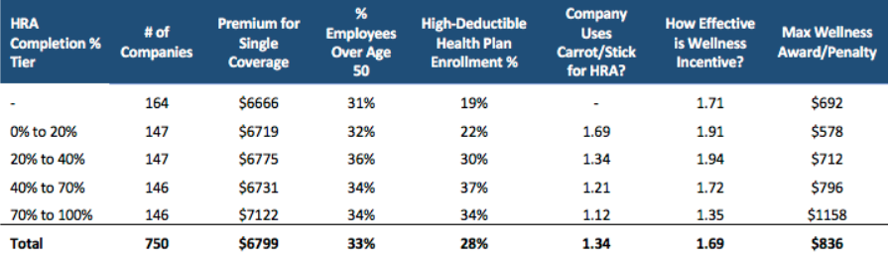
I wouldn’t infer causation from this correlation. That’s because most employees, having been burned in the past by (for example) taking HRA advice to get more prostate exams and eat less fat, now have the good sense not to take the advice offered on HRAs like Cerner’s or Optum’s. Rather, I suspect the causation works as follows: companies that actually think completing Cerner’s or Optum’s HRA is a good idea have applied their very stable genius insights to the rest of their health benefit structure…and hence spend more money.
There are plenty of other shocking factoids in this article as well, so I would encourage people to read the link.
Share this:


Optum’s HRA gets an “F” (though employees who want more opioids will love it)
My recent request to review health risk assessments (HRAs) brought a number of responses. I’m grading the HRAs that I was able to access, on both advice and readability.
Optum’s, the second to be reviewed, receives “F” in advice and, as will be shown below, F- in readability. The scoring system is laid out here.
Advice: Chronic Pain
Optum offers the single most genius piece of advice of any of the very stable HRAs I’ve taken. By way of background, I took this HRA in 3 states where doctors are notorious for regularly giving out opioids as his or her treatment plan to follow, to people who currently have chronic pain. I checked off that I had “currently have chronic pain” just to see if they would say something worth blogging about, and was richly rewarded for that effort:

So this HRA is basically advising me to go get more opioids. The bad news is that they aren’t directing people to Quizzify’s painkiller awareness quiz. The good is that employees who want more opioids will give their program a high satisfaction rating.
Advice: Diet

This advice to switch to lowfat dairy is more likely to cause harm than to create benefit. Full-fat dairy is preferable to fat-free for most people. As this summary, with links to the studies, shows, full-fat dairy probably offers protection against diabetes.
The advice regarding “lower-fat meats” is controversial but is presented as fact. There is a whole body of research saying the opposite of what Optum says. Once again, we aren’t taking sides except to note that coercing employees to complete HRAs implies that the HRAs should be beyond challenge.
“Avoiding adding extra fats/oils when preparing food or at the table,” besides the questionable sentence structure, is simply wrong. Olive oil is on everyone’s good list, for example, while (aside from trans fats) other fats and oils have their advocates. A much better answer — how hard would it have been to come up with this? — might be “substitute olive oil for other fats and oils.” A bigger point: fats and oils make food taste good. And enjoyment of meals will lead to happier employees.
“Avoid added sugar” is decidedly unhelpful advice. Food companies go through a lot of trouble to hide “added sugar” specifically so people don’t avoid it. See this article: The Extraordinary Science of Addictive Junk Food. Optum’s go-to weapon against this cutting-edge neuroscience is: “Avoid added sugar” ?
Alas, Optum’s HRA is silent on how one goes about accomplishing this feat. This decidedly unhelpful advice runs up against the reality that people have no idea where these “added sugars” lurk, since very few products these days advertise: “An excellent source of added sugar.” By way of contrast, Quizzify does teach employees how to avoid added sugar — see the example right on the home page — and a good thing, because Quizzify’s test-takers, while improving greatly over time, originally score as follows:
- 52% think granola bars are healthy (they’re candy)
- 62% didn’t recognize synonyms for sugar (malted barley extract, dextrose, evaporated cane juice, maltodextrose)
- 68% didn’t realize that the first ingredient in a Clif Bar, organic brown rice syrup, is — you guessed it — sugar.
By contrast, this Optum “avoid added sugar” advice is about as helpful as just asking employees to rate their diet, which would be a useless question no HRA would ask. Oh, wait:
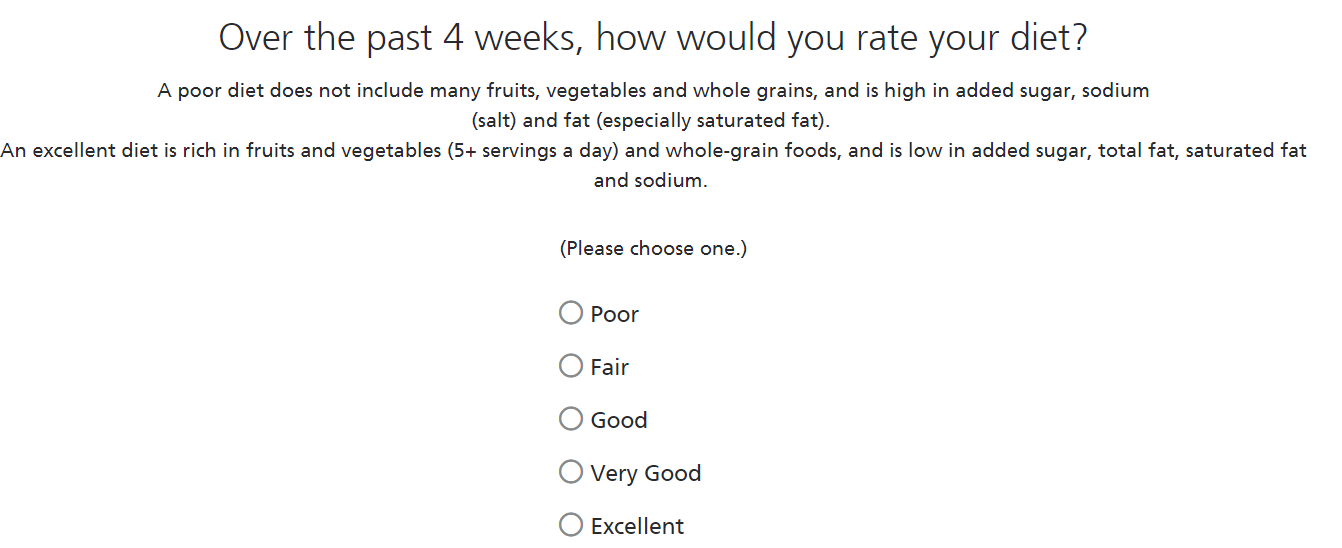
“An excellent diet is low in total fat” is simply wrong information. While saturated fat is controversial, the “low in total fat” myth was killed off decades ago.
While some people’s blood pressure is quite sensitive to changes in sodium intake, blanket recommendations of low-sodium diets are the subject of a great deal of controversy too. The ongoing Framingham Heart Study correlates high sodium intake with low blood pressure, the opposite of what Optum says.
So they’ve told employees to avoid fat and salt. Just to belabor the obvious — and in wellness, the obvious needs a lot of belaboring — what the bleep do they think people are going to eat instead of salty food or fats??? Are they gonna reach for kale, kelp, or a kiwi? Unlikely. They’re going to — get ready — eat something full of that very same added sugar, likely, as noted above, without even realizing it.
Congratulations, Optum. Your HRA greenlights the two biggest no-nos for employees: opioids and sugar. Fortunately for you, few employees take HRAs, seriously, so you probably aren’t doing any harm. This is especially true of yours, because even if someone did want to take yours seriously,you’ve thrown up one more roadblock: people can’t figure out what you’re saying, and that brings us to…
Readability
The complete scale for readability is here. Or so I thought, until I read Optum’s, which requires adding an “-” to the “F” on the scale . I took this HRA multiple times and each time it was an exercise in frustration.

Among other things, there were literally 100 screens that had to be scrolled through. And if you “saved” your work-in-process, you had to scroll through them all again to get back to where you left off.
Here is my favorite screen:

Stay with me on this one:
- If you are a good person, by definition, you check off the following: “I strongly agree that I am a good person.”
- If, by contrast, you are a bad person, by definition, you check off the following: “I strongly agree that I am a good person.”
After all, isn’t the whole point of being a bad person is to pretend you’re a good person? Bad people don’t exactly announce that fact on their Linkedin profiles. Sometimes they don’t even know themselves they are bad people. Walter White thinks he is a good person.

What does this mean?

Stay with me on this one.
- If you do not have asthma, meaning you are at the lowest risk, you check off the third box: “No, not being treated or taking meds.”
- If you do have asthma but are ignoring it, meaning you are at the highest risk, you check off the third box: “No, not being treated or taking meds.”
It’s also not clear how one would get treated for asthma without taking meds, making the second box a head-scratcher too.
Optum repeated this three-box choice for every other chronic disease as well, including diabetes. Diabetes, of course, is a disease that is very common to have but not be treated for. Indeed, it is so common to have diabetes and not be treated for it that there is an entire industry — that would be your industry, Optum — devoted to bribing, coaxing, cajoling or threatening every single suspected diabetic into treatment.
And yet somehow diabetes is nonetheless not common enough for you to draw an additional box on a screen that people can use to distinguish between whether they have diabetes and are not being treated for it, or whether they don’t have diabetes at all.
Indeed, one would think, with 100 screens to scroll through that could easily be consolidated into half that number (for instance, if you don’t use nicotine, you shouldn’t need to scroll through four screens to make your point), the disease inquiry category would be the wrong place to try to economize on electrons by causing people to check off the same box for opposite answers.
To summarize, I’m not following the advice on this HRA, either because it is terrible advice but I need it, or because it is great advice but I don’t need it.
Share this:

Cerner’s HRA scores an “F+”
My recent request to review health risk assessments (HRAs) brought a number of responses. I’m grading the HRAs I was able to complete, on both advice and readability.
Cerner’s, the first to be reviewed, receives “F” in advice and, as will be shown below, D in readability, for an average of F+. Advice is scored as follows:
- A: Virtually all the advice is up to date and correct
- B: The advice is generally correct
- C: There is good and bad advice in roughly equal amounts
- D: Bad advice outweighs good
- F: Employers using this HRA should caution employees not to take the advice
For each HRA being graded, unless otherwise indicated, I am completing them exactly the same way. I am somewhat understating the quality of my diet and the amount of exercise I do, in order to get “mainstream” advice.

High-risk for alcohol and drug use is incorrect. 10 mg of Ambien, taken as directed by a physician, does not create high risk in the absence of other drug and alcohol risk factors.
Ironically, there is a risk in telling people they are high-risk when they aren’t, which is that they will simply lie, in order to move their score left, out of that red segment, and out of the embarrassing range. As a result, they would not exposed to advice they should be getting if indeed they are at risk for drugs and alcohol.
And then they realize it’s OK to lie in general on HRAs. These lies take place on a massive scale, invalidating the entire HRA instrument. In an attempt to create a culture of health, companies are creating a culture of deceit.
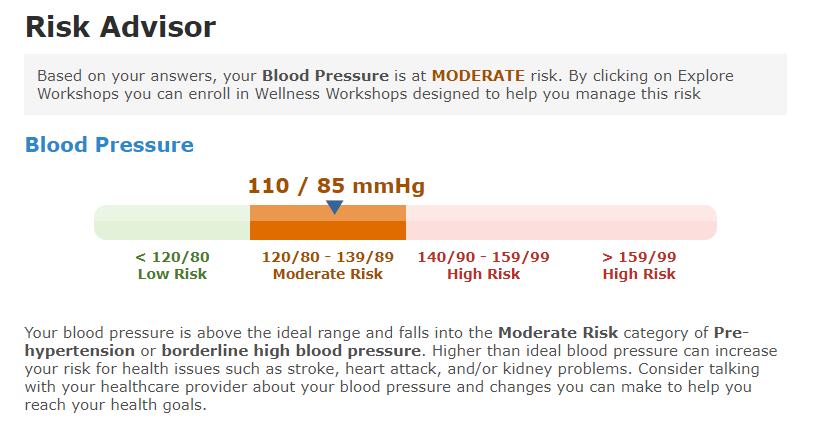
This blood pressure advice is incorrect. Someone with a “pulse pressure” of 25 (110 – 85) is not at “moderate risk” of anything. This is an emergency situation, likely indicating heart failure fluid overload. (This is not my blood pressure, by the way, or I’d be practically dead.)

This advice is wrong on five dimensions.
- People should not be taking blood pressure advice off a computer-generated algorithm, especially one that hasn’t been updated in years. That’s what doctors are for.
- It’s not at all clear that lowering sodium reduces blood pressure in the large majority of adults. This should not be offered as a fact. In some people it makes a difference. Advising people on their own situation is what doctors are for.
- “If you limit your sodium to 1500 mg a day, you can lower your blood pressure even more.” Actually the Framingham Offspring Study says the reverse. It turns out that people who say they consume 4000 mg/day of salt have the lowest blood pressure. (The link is to a lay article that itself links to scholarly material.) Not clear which is right, but advice this controversial should not be passed off as a fact when the evidence conflicts.
- It is possible that this Cerner-recommended low-sodium diet increases cardiovascular risk. Other studies, largely older ones, say this diet reduces risk. It’s safe to say there is no consensus. But HRAs, which employee are being financially coerced into doing, should not be offering controversial advice as fact.
- Telling people to avoid salty snacks may encourage people to eat sugary snacks. The HRA is quite deficient in warnings about sugar.

This advice to switch to lowfat dairy is more likely to cause harm than to create benefit. Full-fat dairy is preferable to fat-free for most people. As this summary, with links to the studies, shows, full-fat dairy probably offers protection against diabetes.
And don’t overlook their complete rookie mistake: telling employees to eat “low-fat or nonfat yogurt,” which of course is full of sugar.
The advice regarding saturated fat in meats is controversial but is presented as fact. There is a whole body of research saying the opposite of what Cerner says. Once again, we aren’t taking sides except to note that coercing employees to complete HRAs implies that the HRAs should be accurate.
Omissions
Further, Cerner’s HRA, as Yogi Berra might say, contains a lot of omissions. The following pieces of advice should be included, but aren’t:
- Advice not to text while driving (in lieu of the seat belts question*)
- Health literacy information on finding hidden sugars
- Health literacy information on finding hidden salt (who knows how much “1500 milligrams” is, assuming that advice were good?)
- Eggs are one of nature’s healthiest foods for most people
- Shingles vaccine addresses the most easily avoidable risk for people over 50
- Questions on opioid awareness (not opioid use, which people will just lie about) and information on how addictive they can be
*Not a useful question and speaks to a lack of updating. While decades ago, a few employees might have benefited from the advice to buckle a seat belt, no employee in recent history has ever not buckled their seat belt, taken an HRA on which they admitted not buckling their seat belt, read the printout that said they should buckle their seat belt, realized for the first time that not buckling a seat belt was a bad idea…and then started buckling their seat belt.
Readability
The scale for readability is:
- A: Intuitive — didn’t even think about any readability issues
- B: Readable enough
- C: Readable with exceptions
- D: Not readable in many instances
- F: Exercise in frustration
Cerner earns a “D” only because, as we will see in a future posting, it is better than Optum’s (F) and Interactive Health’s (F). Absent those two HRAs, Cerner would get an “F”.

Cerner says I am “at HIGH risk for chronic health issues.” But on the right it says I am “moderate risk.” That is confusing and decidedly unhelpful in and of itself. But wait. There’s more…now how much risk do I have?

Having sweated bullets while learning I was high risk and moderate risk, I rest easily to learn that I am at “LOW risk for chronic health issues.”
Eventually I guessed what meaning they were trying to convey, but the typical employee (who, according to Cerner, has to be told to buckle a seat belt) is not going to figure this out.
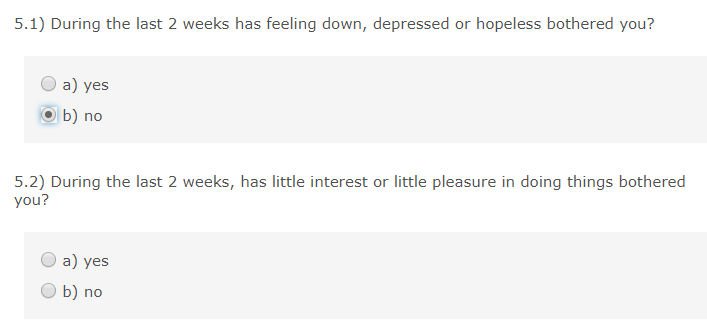
Why couldn’t they just ask if you are feeling down or depressed? (Not that any employee is going to answer that honestly, in any event.)
“Has little interest or little pleasure in doing things bothered you?” Does this mean that if having “little interest or little pleasure in doing things” doesn’t bother you, you write “no”? I had to read this several times to figure out what they were asking.
It doesn’t help that Cerner’s writing style uses a lettering system for no reason. What do those “a’s” and “b’s” add? They do that everywhere, to add to the general confusion:

Lots of extra letters, for no reason at all. And “stroke” and “heart attack” are not “conditions.” They are “events.” Heart failure (a serious disease with an average life expectancy of 5 years) should not be lumped in with angina, which can be controlled for many years with diet, exercise and medication.
Summary
There is far too much advice in here – salt, dairy, meat, drugs, blood pressure just for starters – for anyone to internalize and act upon. It is a tenet of human behavior that the more advice is given, the less is taken. Plus, more importantly, a large chunk of the advice is at least arguably wrong, if not definitely wrong.
Further, the two things that are most important for employees to learn about — sugar and opioids — are pretty much ignored. A good HRA will laser-focus on sugar harms. Likewise, opioids, the leading killer of people under 50. While an HRA can’t cure an addict, questions like: “How long does it take for the first signs of opioid addiction to start, when used as directed?” could measure people’s opioid awareness and then provide easily digestible information on what the actual answer is (3 days). Quizzify has placed its pain management-and-opioids quiz in the public domain, which could fill that gap.
The graphics with all the HIGH and LOW risk scores are very confusing.
Virtually everyone with a drinking problem will lie about it. (Just check the national statistics against the results of this HRA.) This will encourage dishonesty in other answers, and in general create the culture that it is OK to lie to one’s employer.
This HRA, and HRAs in general, make the mistake of giving the same advice to everyone who answers a certain question(s) the same way.
This health risk assessment will not provide a net benefit to a population. It is recommended not to use it, or at a very minimum insist that whoever uses it double-check any advice offered with Quizzify or another source that is up to date and accurate.
Share this:

For a good laugh, send in your vendor’s HRA for review and grading
For some reason in the last few months I’ve been deluged with requests to review health risk assessments (HRAs). Optum and Cerner top the list with multiple requests for review, while Wellsource, Redbrick, Healthmine and of course Interactive Health are also represented. Virgin Pulse too, but since it was only once and since it was with an NDA, I can’t review it except to say that any company that wants a leg up in its own marketplace should urge its closest competitors to use Virgin Pulse and insist that their employees take all the advice.
Among these HRAs, one stands out as worthwhile…and as we get into the reviews over the next month, you’ll see which one. The others shouldn’t be used, or perhaps, since for some reason employers refuse to stop using them, they carry a warning label advising employees to ignore most of the advice. The good news is that, even absent a warning label, most employees are possessed of enough common sense not to take advice from HRAs.
In other cases the advice would be straightforward and correct, like telling heavy drinkers to “cut down on your drinking,” except that virtually no heavy drinker actually admits it on an HRA. (And that particular advice, repeatedly many different ways, is about as useful as telling a depressed person to cheer up.)
You may recall that Wellsteps–the self-proclaimed “best” (meaning “worst”) program in the industry, reported only 20% of employees as drinking (meaning “70%,” the US average), and none to excess (meaning “10%,” the US average).
The self-reported smoking rate? 3%…and most smokers only smoke 3-4 days a week. How silly is that! Everyone knows smokers smoke 5 days a week, with time off for weekends, major holidays, and Beethoven’s Birthday.

In the Soviet Union, workers had a saying: “We pretend to work. They pretend to pay us.” In HRAs, it’s: “We pretend to tell the truth. They pretend to believe us.”
Your mission, should you choose to accept it

If you are an HRA user, you can have your vendor’s HRA reviewed just by giving me a username (maybe your username — you can always go in and change the answers back later if you like) and password.
If you are a vendor and want your HRA reviewed with an eye towards improving it, I can review it privately for a fee. We would then both agree whether the review can be placed publicly. You would also have the opportunity to say publicly what improvements you are planning on, based on the review.
What would be an example of a question that truly epitomizes what an HRA is all about, that will put a smile on our face?
Well, since you asked…
Um, who isn’t going to say they are a good person? Think this over a bit harder than Optum did before they decided to highlight this question as an example of their very stable geniusness:
- If you are a good person, then by definition, you will answer that you are a good person
- If you are not a good person, then by definition, you will answer that you are a good person
Example: Walter White thinks he’s a good person.

Even outcomes-based wellness vendors think they are good people, though not so good that they are willing to have me review their offerings. That’s why it’s up to you.


