
Blog
Wellsteps accomplished the impossible: they got stupider.
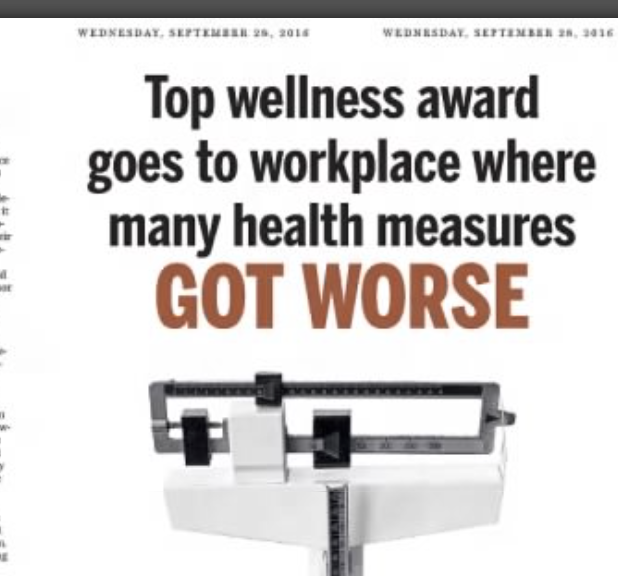
Readers of Why Nobody Believes the Numbers may recall that you can’t reduce a number by more than 100%. This is true no matter how hard you try. And just in case our friends Down Under were wondering, this is not one of those things that’s the opposite in the Southern Hemisphere.

Wellsteps is giving that assertion a run for its money.
Following that headline above (from a full-page spread in the Boston Globe) they’ve doubled down on stupidity to win the wellness industry’s race to the bottom, and, with the demise of Interactive Health, Wellsteps is easily the dumbest vendor in all of wellness.
Still, you have to admire their commitment to stupidity. I and others have pointed out maybe a dozen times that their entire business doesn’t accomplish anything other than harming employees, but they refuse to budge.
Calling them the dumbest vendor in all of wellness is quite a compliment. That’s because the alternative would be to call them the most dishonest vendor in all of wellness. Besides insulting their integrity, that’s not an easy feat to accomplish in this industry. It would be like calling out a specific entitled zillionaire as the most dishonest parent in the entire Varsity Blues scandal.
Perhaps disheartened by their loss of the uncoveted Deplorables Award to Angioscreen after having won or shared two of the last three, they have decided to take stupidity to a new plateau.
Their “Updated ROI Calculator”
The reason they’ve made the news today is that they’ve just published an “updated ROI calculator.” And a big thank you to Jon Robison for forwarding it to me, as Wellsteps has banned me from their linkedin group and everything else.
There are a few things you might want to know about their updated ROI calculator. As you’ll see once you expose it to light, this updated ROi calculator:
- is not “updated“
- doesn’t show an ROI
- doesn’t calculate.
Three lies in three words. That breaks Ron Goetzel’s record of 14 lies in 45 minutes.
No need to take our word for any of this. Here’s the only thing that is updated: the font. This makes it easier to see what happens if you actually try to enter data into this model. Sort of like actually trying to drive a Yugo
Start by zeroing out inflation as a confounder (“0”). Then, for simplicity and consistency, enter “1” into number of employees, as below. I entered $1000 into annual healthcare costs, just to use a round number.
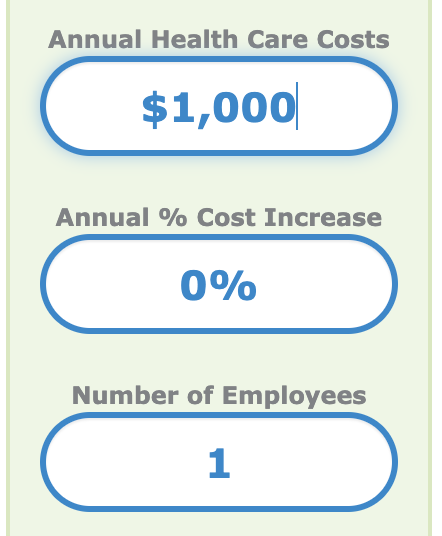
Then let the games begin.
Let’s see how much they save in the best-case scenario. Enter 100% into the two fields “% Employees that [sic] are obese” and “% Employees that [sic] are smokers.”

As an aside, normally one would use “who” in this situation, but they don’t, for two reasons. First, One of Wellsteps’ signature moves is creative sentence structure, spelling, and mixed metaphors. The CEO, Dr. Steve Aldana, called the late award-winning journalist Sharon Begley a “lier.” He once accused me of violating the Law of Conservation of Matter, saying that I am “great at creating BS out of thin air.”
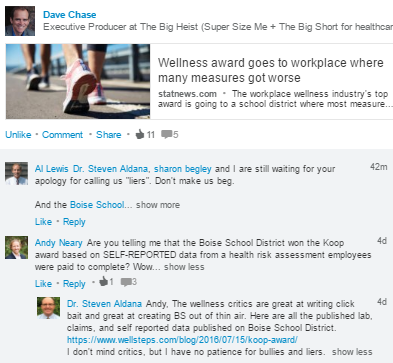
Second, perhaps the reason they preferred “employees that” to “employees who” is because another of their signature moves is to dehumanize employees. Their exact words, subsequently deleted after criticism, were: “It’s fun to get fat. It’s fun to be lazy.”
Back to the Calculator
Let’s see what happens if you do a fantastic job, and reduce the number of “employees that are obese” and “employees that are smokers” from 100% to 0%. So enter those two figures:
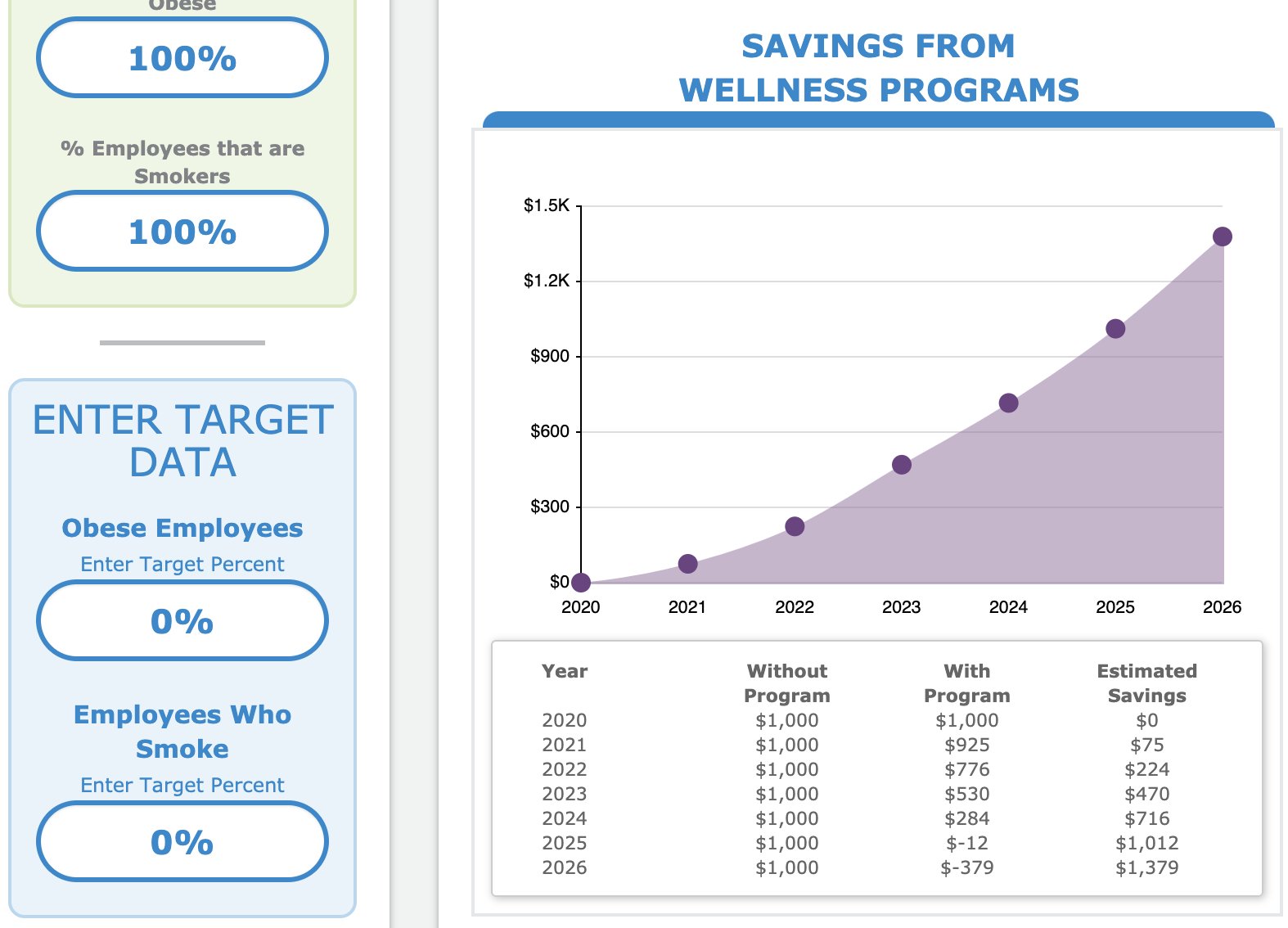
Then go to the right — directly on top of this “hockey stick” graph as you can see, and hit “savings from wellness programs.”
Congratulations. You’ve reduced the $1000 spend by $1379, which is a reduction of more than 100%. While I merely allegedly violated the Law of Conservation of Matter, they’ve just clearly violated a basic law of arithmetic, and those are strictly enforced.
You might say: “That’s not fair. Let’s use a more realistic risk reduction figure, like 0%, which is what all the literature says is achieved:

In the immortal words of the great philosopher Gomer Pyle: “Surprise, surprise, surprise.” You still show mathematicaly impossible savings.

You still show savings even if employees get worse. This is Wellsteps’ signature move in real life, as they harmed the employees at the Boise School district…and still fabricated massive savings:

The actual savings they fabricated — along with their inadvertent admission that costs actually increased — can be found here. Costs can’t go up and down at the same time. Yet another rule of math that is strictly enforced.
What if you don’t have any employees on your health plan, so you spend $0 to begin with? Turns out you can still save a bundle if you have no costs to begin with, even without reducing smoking or obesity.

Before you start fiddling with it, be aware that the very stable geniuses at Wellsteps who came up with this calculator once accused me of “entering false data” into it. So make sure your “data” isn’t “false.” To avoid that:
- use only arabic numerals…
- …in base ten.
Turns out no matter what data you enter, you save money. Don’t take my word for it–see it with your own eyes.
Stupid? Well, let’s just put it this way. NASA engineers need not worry about their job security on account of Wellsteps, because these people are not rocket scientists.

Or Wellsteps’ CEO, Steve Aldana, actually dishonest?
Let’s examine the evidence both ways. Here are the three best arguments for stupid:
- He says he needed 11 years to get through college. (p. 7) That’s 4 more years than Bluto Blutarski.
- He thinks “even one more bite of a banana” will improve your health.
- He is friends with Ron Goetzel.

Here are the the three best arguments for dishonest:
- He admitted that his alleged savings at the Boise School District was just regression to the mean. (Scroll down.)
- He knows this “model” is fabricated and has criticized me for pointing that out.
- He is friends with Ron Goetzel.
And let’s not forget that Wellsteps’ claim to fame is actually bragging about harming employees. To this day, they are the only vendor willing to publish data admitting that employees got worse on their watch. And that puts them in a category all their own. Like Juan Garcia, whose espionage work won him the highest military awards from both Germany and Britain, this performance earned them both a Koop Award (see #3 above) and a Deplorables Award.
Does that mean they are dishonest, stupid, or both? To slightly paraphrase the immortal words of the great philosopher Clarice Starling, there isn’t a word for what they are.
Update: Many of you know about the $3 million reward for showing wellness works. If Steve Aldana and his team of very stable geniuses with very good brains can show that their calculator is more accurate than Quizzify’s ROI calculator, I am doubling my $3 million reward and halving the $300,000 entry fee. The rest of you can stop reading here. Steve, that would be a $6 million reward for a mere $150,000 entry fee.
Share this:

“Overcoming Employee Vaccine Hesitancy” webinar now features CDC guru!

Until now, the word “emergency” has never been used to modify the word “webinar.”
But this April 7th webinar is kinda sorta an emergency, by webinar standards. COVID vaccine hesitancy could derail your entire return-to-work effort by polarizing your workforce. This topic is not just clickbait for Quizzify to get more business (though that too). It’s been widely reported in the last several weeks:
• Employee Benefit News (“Vaccine misinformation is a hurdle”)
• The New England Journal of Medicine (“Overcoming COVID vaccine hesitancy”)
• The National Library of Medicine (“A Challenge the US must overcome”)
But the good news comes from a widely reported focus group of vaccine skeptics. 19 out of 20 of them changed their minds after learning more from objective sources. One said: “We want to be educated, not indoctrinated.”
And this simple 45-minute webinar —Wednesday, April 7 at 1 PM EDT — will show you how to do exactly that, starting now. Plus, you yourself can test your COVID vaccine IQ in real time with a few of our “Vaccine Mythbusters” questions.
The Expert Panel
We are featuring two Experts, with a capital “E,” to address your questions, Dr. Christa-Marie Singleton and Dr. Scott Conard. In any ordinary webinar, Scott would get top billing…but this is no ordinary webinar.
Dr. Singleton is the Associate Director for Science and Science Lead in the CDC’s COVID-19 Response Chief Health Equity Office. She is also the Senior Medical Advisor in the CDC’s Population Health and Healthcare Office where she serves as the senior medical advisor regarding planning with commercial insurer partners and physician providers. In terms of COVID and the COVID vaccine, she works with teams to include health equity principles in science-related projects and improve the impact of COVID in disproportionally affected populations.
She will be joined by Dr. Scott Conard. One of the country’s best-known practicing family physicians and Linkedin commentators, Dr. Conard also serves as Medical Director for corporations and regional benefit coalitions. As such, he will apply his unparalleled understanding of the intersection of corporate communications with employee/patient concerns to show attendees how to overcome vaccine hesitancy.
Or you could just cut to the chase and contact us about getting started with the full set of questions posthaste.
Share this:

Monday at 1 PM: a webinar featuring Dr. Marty Makary, Leah Binder, and Marshall Allen
Dear TSW nation,
So maybe this posting is not funny like last month’s, when Angioscreen won the uncoveted Deplorables Award. But “funny” isn’t going to give you insights into how to perform more effectively — other than, of course, not using Angioscreen, a decision that will benefit your workforce immeasurably.
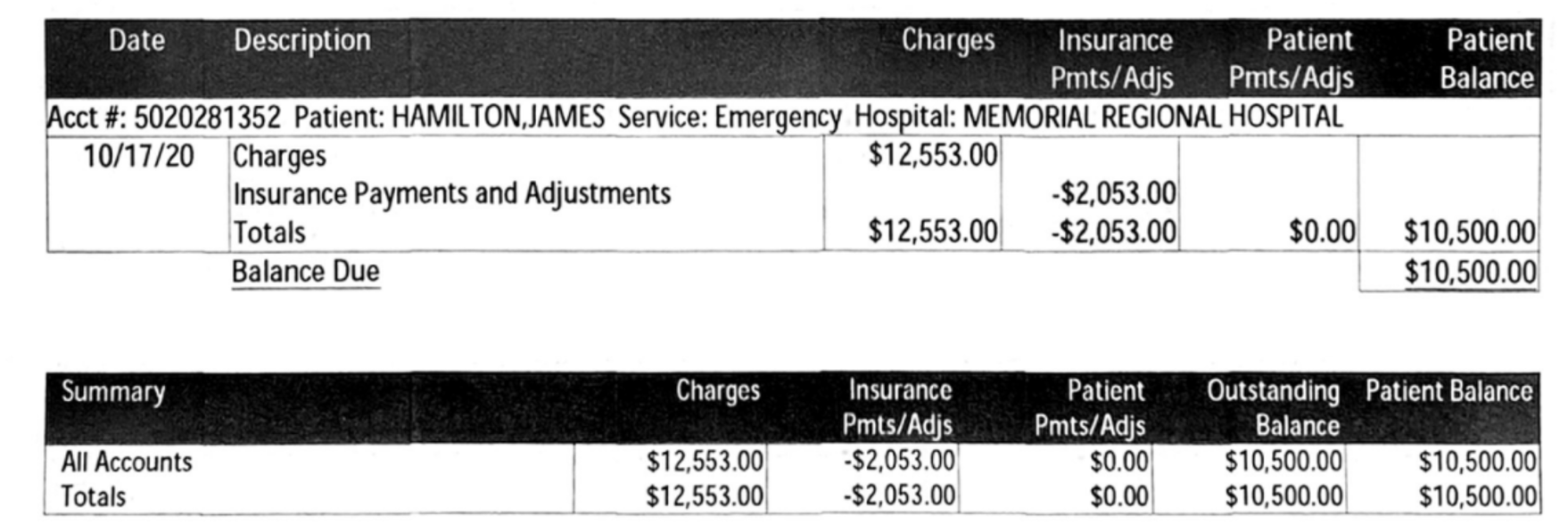
This posting has a bit more substance to it, announcing a webinar Monday, March 22nd at 1 PM EDT on “Hospital Financial Ethics.” It will feature a real price-gouging incident with a real bill — and a real patient with a real name (James Hamilton).
This bill will be deconstructed by an expert panel. I am humbled (which doesn’t happen often) by the talent we’ve been able to attract to this panel, none of whom even need an introduction:
- Marty Makary
- Leah Binder
- Marshall Allen
And as long as you are signing up for our webinars, there are more on the docket (all at 1 PM EDT)
April 7: An “Emergency Webinar” on overcoming vaccine hesitancy in your workforce.
April 22: The best premature birth avoidance technology we have ever seen…and we never endorse vendors. We’re making an exception here because they actually do something that employees love and saves money besides.
May 12: The Top Ten Easiest Employee Behavior Changes. Turns out — who knew? — that employees can’t keep weight off, they don’t like broccoli, and they already buckle their seat belts. But there are ten behavior changes that either save money or improve health or both, that are so easy to make you don’t need to bribe or fine them.
June 15: Never Pay the First Bill. A pre-publication look at Pro Publica uber-investigator Marshall Allen’s new book of the same name on how not to get snookered by a healthcare bill.
July 15: Featuring Dr. Eric Bricker (yes, the very same) on aligning incentives with your providers, your PBMs and your consultants.
Share this:

You can stuff that colonoscopy! Here’s something better.
This is reprinted from Quizzify. I probably should have posted it here in the first place because, as someone has already noted, my particular style of writing works very well with this, uh, material.

As you can no doubt tell from all the store window displays and promotions, March is colorectal cancer awareness month. That’s only the start of the good news.
The other good news is that the colonoscopy guideline-writers, whom I suspect are all over 50 by now, don’t want a colonoscopy any more than you do. Hence, they now say a colonoscopy once every ten years is OK, up from every five.
The procedure itself is uncomfortable and carries a 1.7% chance of a complication. That means a company with 150 people getting screened will see two landing back in the doctor’s office, the ER or even the hospital. (The odds are actually a bit more favorable than 1.7%, because complications are more common in older patients.)
And that fluid they make you drink for 24 hours beforehand? I don’t know what’s in it but, in the immortal words of the great philosopher Dave Barry, it should never be allowed to fall into the hands of America’s enemies.
The better news is there are three non-invasive alternatives that can avoid both the discomfort and the complications of a routine colonoscopy screening. This blog post looks at each in turn.
But before you click through to that page-turner, don’t forget to register for the March 22nd webinar featuring healthcare uberstars Marty Makary and Leah Binder, speaking on the oxymoronic topic of Hospital Financial Ethics.
Share this:

Six reasons to attend today’s webinar on the new EEOC rules. (Much less boring than it sounds.)

Unless you follow the EEOC very closely, you are likely unaware that the Biden Administration is putting the kibosh on conventional “pry, poke and prod” wellness programs.
Here are six things about this kibosh that will be covered in today’s webinar at 1:00 EST.
- Your Safe Harbor is kaput. If your program has a strong clinical component, you are out of compliance, period.
- The AARP v. Yale decision, likely within the next 8 weeks, will arouse the plaintiff bar, and we can expect more lawsuits (unless it is settled).
- At the very least, that decision will spur many more EEOC administrative hearings/sanctions. While financial exposure there is very limited, the career-limiting embarrassment of being caught out of compliance for two years is not.
- How sure are we that the court will rule against Yale’s program unless it is settled? Quizzify is offering to double our contract lengths free to anyone who signs up before that happens, if we are wrong.
- There will be no “grace period” or “transition period.” In the 2017 AARP v. EEOC case, the judge stayed compliance until January 2019. The grace period train has left the station.
- If you don’t attend, you’ll be one of the few people who aren’t. 800+ people are already signed up.
This webinar will show you how you can easily comply within days…and immediately make your program more effective and more engaging. All with no changes to incentives, penalties, clinical components, or even your budget.
PS Register today even if you can’t attend. You can access the recording later. Or just cut to the chase by contacting us directly at Al@Quizzify.com
Share this:


Your employees won’t think COVID is just a “bad flu” after they read this
Remember “El Paso” by Marty Robbins? At the end you were pretty sure he was going to die because he “felt the bullet go deep in his chest.” Somehow he made it back to the bar where the guy whose girlfriend he tried to steal (before he stole the guy’s horse) let him and her profess their love while he (Mr. Robbins) was apparently bleeding to death.
The only way you know he survived is that he recorded a song about the mishap.
Well, likewise, the only way you know the author of this blog post about COVID survived is that he wrote the blog post about it. it is a richly detailed, harrowing, painful seemingly unending tale that will scare anyone who reads it into wearing a mask anad taking other safety precautions beyond just the “six foot rule.” Makes Mr. Robbins’ bullet wound sound like a mosquito bite.
I would recommend forwarding Mr. Bujalski’s posting to your employees if they have any doubt whatsoever about whether COVID is a “hoax.” (Mr. Bujalski is very much on the mend but nowhere near 100%, and I’m sure he would appreciate a visit to his blog to send him best wishes for a full recovery.)

When I created this blog, it was my intent to post thoughts, insights, or musings at least once a week. Unfortunately, it has been over two months since I last posted an entry here. The circumstances that interfered with those intentions are suggested in today’s title.
It is important to note that from the beginning of the public health warnings regarding the coronavirus, my wife and I took every advised precaution. We were dedicated “maskers.” We washed our hands frequently. We avoided unnecessary social contact, and when we needed to go out (grocery store, take-out food), did our best to maintain six feet or more between us and other people. If anything, I was compulsive in adhering to the guidelines, perhaps taking them to extremes: I wore nitrile gloves to the grocery store and washed the purchased fruit and vegetables when I got home. Sadly, we had to cancel two planned trips to see grandchildren in other states. We were careful.
Yes, we were careful, but not 100% isolated from the outside world. We’ve given much thought to where we might have been exposed to the virus. As dining out restrictions were lifted in NC, we did venture out to dinner once a week, typically on a Wednesday. We wore masks into a restaurant, only took them off to eat or drink, then wore them as we left the restaurant. The staff at these restaurants always wore masks. The restaurants never had many people, and we were at least 8 to 10 feet away from other diners.
(Editor’s note: 8 to 10 feet helps, but there is no magic in a specific distance in indoor spaces. Just probabilities of infection that decline fairly linearly with distance.)
One other possibility: My wife attended pottery classes at a community college. Everyone wore masks, and attendance was limited to allow for social distancing. However, there was a pair of “shared goggles” that people wore when using the grinder to smooth edges of fired pieces. While most of what we’ve read suggests that it is unlikely that COVID can be transmitted via the eyes, we’ve considered this as a possible source…
Share this:

Sharon Begley, renowned journalist and wellness chronicler, dead at 64.

I am saddened to report the loss, over the weekend, of perhaps the best health/science writer of her generation, Sharon Begley. Though a “never-smoker,”, the cause of death was lung cancer.
To appreciate the full scope of her accomplishments over her 43-year career at Newsweek, the Wall Street Journal, Reuters and STATNews, peruse this obituary. A highlight (along the many other highlights, including 5 books) might be:
She won more awards and accolades than could fit in an obituary. The accomplishments she was prouder of were making complex ideas accessible to anyone — and beautiful — through her articles and books, and in doing so, training and inspiring generations of science journalists. She taught by example, showing that you could be tough-minded while being kind, that you could be literary without any big-personality bull.
And kind she was. We found common ground and shared hilarity in our respective exposes of the wellness industry and its many foibles. We bonded over this and became good social friends over the last four years of her life, as she and her husband Ned joined our group for bridge and games nights, while Ned played ultimate frisbee with us.
But let’s get to the “kind” part and — rather than duplicate what other obits have said — focus on her contributions to the wellnss industry.
One of her gifts as a journalist was interviewing people in such a kind, low-key, manner that they would accidentally tell the truth. While she wrote many articles on wellness, one article exemplifies this talent, as we bridge players might say, in spades: Top Wellness Award Goes to Workplace Where Many Health Measures Got Worse.
In it, she documented the dishonesty/corruption of the Koop Award, and the harms to the employees of the Boise School System caused by the “award-winning” Wellsteps program. Over the course of two years, Boise teacher risk scores deteriorated by 20%, self-reported health status declined, and costs increased.

Needless to say, the perps wouldn’t talk to me, but she got them to spill their guts before they even realized they had just self-immolated. Specifically, Wellsteps’ CEO, Steve Aldana, admitted to:
- knowingly using regression to the mean to fabricate a claim of risk reduction among the highest-risk employees
- recognizing that trivial self-reported changes in (for example) fruit and vegetable consumption had no effect on healthcare costs
- recognizing that wellness programs increase overall costs
- violating US Preventive Services Task Force guidelines.
She got Ron Goetzel to admit to bestowing an award on Wellsteps for improving employee health despite knowing they harmed employees. (Mr. Aldana served on the awards committee but was the only committee member vendor who hadn’t won one of its own awards, so his award was predictable — and actually predicted.)
But her kindness wasn’t used just for the purposes of extracting self-incriminating information. When Steve Aldana called her a “lier”, her reaction was: “I need to find out what I got wrong, correct and acknowledge it,” as opposed to my own reaction, which was to quote him verbatim. Of course, she never heard from him again.
And the truly kindest thing she ever did was, despite the delicious irony, decline to write anything more about Ron Goetzel after he suffered his heart attack. I should be so kind! (On the other hand, he still maintains enough of an ejection fraction to summon the energy to attempt to sully my reputation, so I still defend myself.)
Two other articles — subsequently picked up by major media outlets — probably helped galvanize opinion to prevent employers from genetically testing employees and their dependents for hidden disease as part of workplace wellness programs:
- Opposition grows to ‘workplace wellness’ bill that would scale back genetic privacy
- House Republicans would let employers demand workers’ genetic test results

She also helped put the kibosh on yet another Goetzel-infused idea, this one to create a so-called “fat tax,” which would require employers to disclose the number of overweight employees, the idea being this would encourage employers to use more punitive and expensive wellness programs. (She handed this one off to a colleague.) It would likely have backfired, but wiser heads prevailed, largely thanks to this article, and Ron’s idea was stillborn.
Two others:
- Do workplace wellness programs improve employee health?
- Think preventive care saves money? Think again.
Sharon, we miss you already and it’s only been 2 days. Thank you for your great contributions to the workplace wellness field. They played a major role in curbing its excesses, and also for generally improving the health-and-science literacy of the population for more than four decades. And for that time you didn’t double my rather aspirational 6-hearts bid even when you had the other five hearts in your hand.
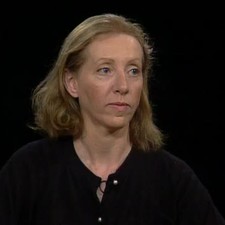
June 14, 1956 to January 16, 2021
R.I.P.
Share this:


“New” EEOC wellness incentive rules now DOA!
Within minutes of Quizzify’s blast email predicting that the EEOC’s rules released two weeks ago would be DOA, it is now a lock that they are toast. The White House made two announcements last week confirming this:
- They froze all non-emergency Notices of Proposed Rulemakings (not a misprint — two plurals)
- They rejiggered the EEOC, promoting the two pro-employee Commissioners to the Chairmanship and Vice Chairmanship.
This means the huge loophole in the announced rules, allowing most outcomes-based wellness programs, will be closed.
Is this an existential threat to the wellness industry? At first glance, it would seem to be. But you can join our webinar to learn so this existential lemon can be turned into existential lemonade.

Leading wellness attorney Barbara Zabawa and I are hosting a webinar on this topic on Monday, February 1st, 1:00 EST. You can register here (and get access to the recording and slides as well.) Focus will be on how to ignore the new rules, and maintain your program as is. Yep, just like with surprise bills, we’ve figured out how to game the system.
The EEOC has just released their rules for clinically based wellness programs.This step is called the “Notice of Proposed Rulemaking,” or NPRM, to be published in the Federal Register’s mellifluously named Notices of Proposed Rulemakings for public comment. “Public comment” is code for “the perps with the most to lose will flood the thread with disinformation.” Expect the US Chamber of Commerce, the vendors and Ron Goetzel and his cronies to weigh in heavily, each more shamelessly than the next. They have a lot of (your) money at stake here.
When NPRMs are posted for public comments, you know who never makes public comments? The public. So it’s up to you and me to pick up the slack, and point out that these perps have no clothes. Feel free to grab posts from TSW to add to the comments.
And the envelope please…
Most importantly, incentives for participation-based programs need to be cut back to “de minimis.” And, unlike when the rules were first floated (and true to the intent of the judge who found that forced wellness programs were not voluntary), de minimis has been defined. It looks like the IRS definition — water bottles, t-shirts, small-denomination gift cards. I had thought perhaps $200 would be OK. That is clearly outside the realm of de minimis. That could change if the perps flood the comments.
My own opinion: it is perfectly ok, even desirable, for organizations to offer employees screening. Just don’t make them do it. I myself voluntarily get my Hb a1c screened every year, to make sure I’m playing enough ultimate frisbee to offset my consumption of LA Burdick’s insanely good chocolate.

And it is perfectly OK to educate employees on why they should want to get screened (or, in the case of younger, healther employees, why they shouldn’t). Screening would then be truly voluntary.
However, many organizations want to maintain their current participation-based programs with their current incentives or penalties…and many vendors want to keep their revenues intact.
For these groups, Barbara and I are offering this webinar, to show how to do exactly that.
So far, so good, but…
That was all about participation-based programs. Health-contingent, or outcomes-based, programs are a different story altogether. The EEOC is basically pro-employer these days. So they have figured out how to circumvent the spirit of Judge Bates’ December 2017 decision vacating the old rules in which forced programs were defined as “voluntary,” without violating the letter of his decision. But this massive loopholecould circumvent the ruling only for outcomes-based programs, not participatory ones.
This loophole allows you to continue to be able to subject employees to fines of thousands of dollars in outcomes-based programs. Most employees hate being forced to submit to these programs (“I’d like to punch them in the face,” said one), and they invariably lose money. However, the losses in program fees and employee morale — all admitted by the wellness industry trade association — is more than offset by the “immediate employer cost savings,” as Bravo puts it, generated by collecting the penalties from employees who refuse to let unlicensed wellness vendors play doctor.
However, most outcomes-based programs, while arguably complying with these new rules under the Americans with Disabilities Act, violate the Affordable Care Act. With the well-documented, Validation Institute-validated exception of US Preventive Medicine, they invariably fall short of the ACA’s standard of being “reasonably designed to reduce risk or prevent disease.” That hurdle was set low enough to allow even the worst outcomes-based wellness vendors to clear it, and yet they don’t. They violate guidelines with impunity, forcing employees to undergo tests that no doctor would ever order and that get D ratings from the US Preventive Services Task Force (USPSTF).
Just too many epic fails, all documented for the last five years on this blog and sometimes in the media, including Koop award winners like Wellsteps, arguably the industry’s worst program now that Interactive Health has gone bankrupt. Ironically, Wellsteps is also among the best-documented programs. Why they insisted on publishing their own self-immolation is anyone’s guess. No one can argue that programs violating the USPSTF guidelines and, as we’ll see, harming employees, could possibly be considered “reasonably designed to prevent disease.”
This is not just about the money.
Outcomes-based programs can and do harm employees. Sometimes wellness vendors — I’m looking at you, Wellsteps — even admit their harms.
Yale employees sued Yale, for example, due to the psychological and physical harms of their program. One Yale breast cancer survivor was almost forced into getting a mammogram, even though she had already undergone a double mastectomy. Had it not been for Yale’s union and the AARP’s support, she would have been fined $1250.
TSW has published many stories of harms, summarized here. Not to mention what happens when you fine your employees for not losing weight. Guess what — they respond in very predictable fashion, packing on the pounds before the weigh-in and then crash-dieting to take them off. And our #1 most-searched phrase? “How to cheat in a corporate wellness program.” https://dismgmt.wordpress.com/2019/01/07/breaking-shocking-news-employees-cheat-in-wellness/
Still, if you insist on keeping an outcomes-based program, the “hack” we’ve figured out of the new regs applies to outcomes-based programs as well. Seriously.
So if you have a program (and very few people with outcomes-based programs read this blog, or else they would have already dropped them), you’ll want to attend the webinar to figure out how to preserve it. And if you don’t have a program, you’ll want to attend just to understand what the EEOC tried to do with this massive loophole and how we got the better of them.
Share this:


Scary new COVID strain will be landing in your neighborhood soon
As though the current COVID isn’t transmissible enough, this new strain spreads about 70% more easily. Hence 70% more urgency to educate your employees/members here and now. (Not quite sure that’s the way the math works, but close enough.)
The strain has already been found in 3 states. And the two countries in which it is already firmly established –Britain and South Africa — have already suffered dramatic increases in case rates.

It is believed that the vaccine(s) will protect against that strain too. Unfortunately, the anti-vaxxers have launched a disinformation campaign featuring enough lies to make a wellness vendor blush. And that doesn’t even include lying about the new strain, at least not yet.
Here is an example of an antivax myth perpetrated by someone on a health-and-wellness listserve, no less, that is so embarrassingly stupid that — even though this site is devoted to publishing embarrassingly stupid things that wellness vendors say — we aren’t going to mention any names:
According to actual infectious disease experts (Dr. William Schaffner at Vanderbilt, Dr. Anthony Fauci), and government and FDA documents in regards to vaccines, Pfizer has caused 6 deaths (within 3 days of vaccination)
- Randomly, about 6 deaths would be expected in 9 months and 40,000 adults
- Within 3 days of the vaccination, no one died
- No deaths were attributable to the vaccination at all, and (drumroll)
- 4 of the 6 deaths were in the control group.
It kills us to withhold the perp’s name (we will make it available upon request) but because COVID is life-threatening, we thought it would be better to focus instead on the positive, such as it is.
The “positive” is that the coming “surge” within your own organization — and, don’t kid yourself, it is coming, due both to holiday gatherings as well as the new strain — can be mitigated, if you choose to do so. You have four choices:
- Send out information and link employees/members to your “COVID resource center” which has more information — and hope that no one relies on social media instead for their “information”;
- Within the next week or two, write concise and thoughtful sets of COVID educational trivia questions about both safety precautions in light of the new strain and myths about the vaccines, put them in an elegant user interface, and get a major medical school, like, to use one random example, Harvard, to let you put their name on the questions to ensure credibility;
- Retain Quizzify, which has already done exactly that and is ready to go tomorrow with two full quizzes, and a customized and linked landing page like the one at the bottom, for your organization
- Do nothing.
If history is any guide, the overwhelming choice will be #4. Those people should also have their names named, but we won’t. Instead, we’ll just observe that every time one of your employees takes ill with COVID, remember that you could have done something about it, starting tomorrow.

Share this:

Announcing the 2020 Vendor of the Year Awards
In the past, we’ve lovingly bestowed Deplorables Awards upon wellness vendors whose multicolinear combination of dishonesty, incompetence, ignorance, and friendship with Ron Goetzel have also earned themselves Koop Awards and in at least two cases, a trip to bankruptcy court.
Fortunately, the “pry, poke and prod” industry is asymptotically approaching irrelevance. It’s not just that many companies’ employees are remote and therefore difficult to screen, or that the EEOC is about to put the kibosh on financial inducements to screen.
It’s that screenings have now been proven not to save money. I don’t mean workplace screenings are not proven to save money. I mean they are proven to actually lose money thoroughly enough to disprove the maxim that it’s impossible to prove a negative.
Consequently, the “pry, poke and prod” companies now operate mostly in the shadows, their market being limited to employers who lack internet connectivity. The downside of their reticence is that we don’t have any vendors to laugh at anymore. Last year we turned that lemon into lemonade by naming the individuals who had contributed the most to employee health services through 2019, winners of the “Not the Deplorables Awards.“
Continuing in that vein but switching from people to companies, this year we are recognizing the vendors who have contributed the most to employee health services. To qualify, a vendor must:
- Not have been, uh, “profiled” in They Said What? That rules out most companies;
- Be validated by the Validation Institute;
- Have seen selected or will be selected as a “Valid Vendor of the Month” By Quizzify, which means their performance is partially guaranteed by Quizzify in joint accounts.
Here is the list. We’ll put it in alphabetical order.
They take utilization review and case management to a Quantum-like level, for companies not big enough for Quantum. Here is our write-up of them and the webinar. Reviewing their figures very carefully showed us that in fact they do reduce utilization qutie noticeably.
In lieu of a major PBM, giving your employees who fill prescriptions a Drexi card is a cash-on-cash no-brainer. Notice anything missing from my family’s claims summary? Yes, that’s right. Claims.

In case you can’t read that, it says a grand total of — get ready — $44.30 was spent by our family on healthcare in 2020. Actually we spent a little out-of-pocket on drugs, but a Drexi card means no PBM and hence no reporting. I was never even asked who my insurer was.
The Drexi all-in price was lower than the co-pays alone would have been had we involved the PBM. Fewer middlepeople mouths to feed means lower prices. Oh, that $44.30 was an antibiotic I needed in a hurry and was nowhere near a store contracted with Drexi. It would probably have been $4.75 if I had taken the time to find one. (Note: you do need to give your prescription-using employees a Drexi card, but the annual cost of those can be recouped in one fill, for many drugs.)
They are the leaders in the unfortunately altogether-too-necessary category of reviewing provider bills to uncover, challenge and recoup insanely and often hilariously inappropriate charges, like $139,741 for an outpatient procedure to remove a few unslightly veins.
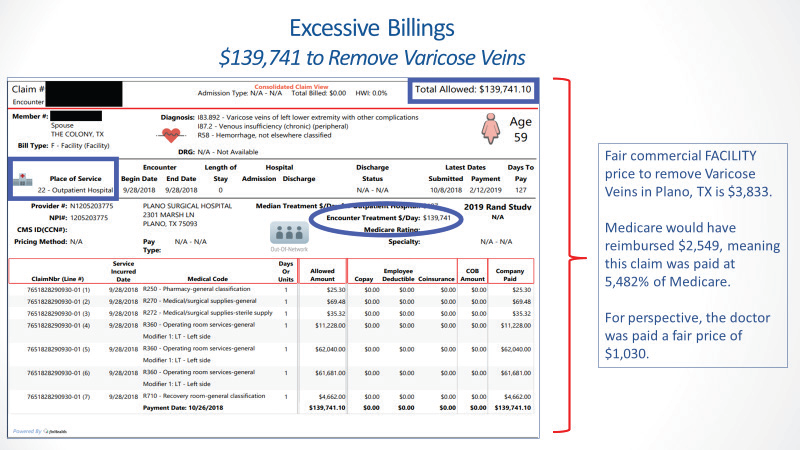
They are so certain to find savings that they usually don’t even charge. They merely take a share, so you can’t lose.
OK, so they are technically not a vendor but they did accomplish a milestone this month: reaching their 20th birthday without a hint of scandal and no potshots other than by hospitals with low scores. (Those potshots actually increase their street cred, just like potshots from wellness perps improve mine.) In 2021, they will be adding a financial component to their ratings: measuring a hospital’s use of surprise bills settled by judicial decree.
Never has a journal article showing savings been as thoroughly reesearched, as carefully vetted, as comprehensive, as valid, or as contrary to my expectations as theirs. It generated a lot of interest. I myself was skeptical enough of their findings to make them jump through a bunch of plausibiltiy hoops on behalf of the Validation Institute, to ensure the continuation of VI’s 7-year streak of zero challenges to their validations.
The Bottom Line: their program actually saves money…and the Validation Institute will now guarantee that.
So we’re already up to Q. I’d be lying if I didn’t admit this is my favorite letter.
Quizzify has revealed enough ways to save money through education that it’s almost impossible not to sign up for employee health literacy. After all, is there any other expense line item where employees receive an unlimited budget with no training in how to spend it? We didn’t think so.
Among the things we’ve taught this year, uniquely in all cases, are:
- Avoiding surprise bills for non-elective care
- Disintinguishing tick bite symptoms from COVID
- Downloading questions for the doctor right into your Apple Wallet
- Treating cavities with SDF for $30 instead of drilling them for $150
- Predicting premature births with surprising accuracy
Further, while those insights make Quzzify the industry’s leading content tool, Quizzify offers the ultimate engagement tool: twice as engaging as your other benefits or your money back.
Remember those old Wendy’s ads where someone would be asked whether they wanted a fresh and juicy Wendy’s hamburger or a dry patty on a stale bun…and they’d always pick the latter?
Well, likewise, the vast majority of employers cover prematurity tests that are 17% accurate instead of educating pregnant employees on why they might prefer a test that’s 88% accurate.
And yet, that’s exactly what they would get with Sera.
In 7 years, they’ve never being successfully challenged on a validation, so one could call them the anti-HERO. And, finally, after enjoying those seven years of zero challenges, they’ve announced a rock-solid Credibility Guarantee as a bet that they never will be called out on a validation. Assuming they add the VI-recommended clause to their contract, any customer of any validated vendor that feels the validation was in error can collect up to $25,000 from the VI, in addition to whatever guarantees the vendor offers. So in the case of Quizzify, you get their guarantee and ours.
Honorable Mention: Health Enhancement Research Organization (HERO)
Yes, that HERO. Without them as a soft target, we wouldn’t have a website, now that Interactive Health is defunct. While it has been a blast quoting them verbatim, they’ve finally come to the realization that none of their claims of savings from “pry, poke and prod” programs overlap with reality, and they’ve finally stopped defending them.
On the one hand, their stupidity was pretty astounding. On the other hand, you had to admire their commitment to stupidity.
So obviously they aren’t validated and never will be. We haven’t done a webinar with them and never will. And we don’t guarantee their allegations and never will. They are getting this Honorable Mention for having gone 12 months without saying anything preternaturally stupid or dishonest, at least in public.
They are the lucky beneficiaries of the immortal words of the great philosopher philosopher George W. Bush: “The soft bigotry of low expectations.”

 They Said What?