
Blog

Answer Leapfrog’s 20th Birthday Trivia Question to win $100
Dear They Said What Nation,
To celebrate Leapfrog’s 20th Birthday Week, Leah Binder posted 3 questions in our chat on Linkedin. One of the 3 remains unanswered…and I am personally upping the ante to $100 for the first correct answer!
So have at it. Here is a hint: this person was an overnight sensation before become the person with the most things un-named for him. The full question is in the interview.
Once again, Hppy 20th Birthday to Leapfrog!
Dear They Said What Nation,
Happy 20th Anniversary to The Leapfrog Group. In 20 years they have become arguably the most untainted healthcare not-for-profit in DC. It’s not easy to stay untainted for 20 years, but they have. By contrast, providers, PBMs and vendors “sponsor” other groups, and — get ready — the other groups advance their agendas instead of consumers and employers. Simply doesn’t happen with Leapfrog.

Even though it’s their birthday, you’re the ones getting the presents. Yes, members of TSW Nation can actually win prizes. Not for blowing the whistle on dishonest wellness vendors (though that too), but rather by answering a couple of general interest trivia questions right. If someone does the Mary Wells thing and guesses ahead of you, you can still at least be entered in a runner-up drawing
As of this writing, there are no correct answers yet…though everyone has heard of the two people and you’ll kick yourself for not guessing right.
Once again, here is the link. No time to waste, as the deadline is 4 PM today.
Share this:


Architect of Wellness’ Biggest Victory Dead at 84
Michael O’Donnell, former prevaricator-in-chief of the wellness industry trade magazine and best known proposing that employees be charged for insurance by the pound, once claimed that “pry, poke and prod” programs were as important to public health as antibiotics and sanitation.
You can debate that premise (or, more likely, laugh at that premise) all you want, but there is no debate about the #1 public health victory of all time: the conquest of smallpox.
Smallpox likely disabled or disfigured a billion people and killed hundreds of millions (including most of the native population of the New World).
Until it didn’t.
The man most responsible for the conquest of smallpox, Dr. J. Michael Lane, died yesterday at 84. He spent much of his lengthy CDC career on this quest, taking him all over the world. And, as you can seee below, I do mean literally all over the world.

He also happened to be my uncle.
What this lengthy New York Times obituary — recounting the history of smallpox, among other things — doesn’t mention is that he was also the nicest guy in the world. His modesty, apparently a recessive gene in my family, became him. He opened his keynote at the 25th reunion of his Harvard Medical School class by saying: “I’m the lowest-paid guy in the room.”
This will shock everybody but he also hated corporate wellness. He and I used to get a chuckle out of the hilarious chronic-disease statistics that his very own CDC published, like their “arresting fact” that 7 out of 10 deaths in the US are due to chronic disease. Not sure what else the CDC would like people to die of, but Mike observed: “Most countries I visit are lucky if it’s 2 out of 10.”
The CDC is quite controversial now, but this victory shows that when they put their mind to it, they can accomplish great things, this being perhaps the greatest of all.
Share this:

Congratulations to Medencentive!

Some people think this blog reports only report Vendors Behaving Badly, of which there is no shortage. Hence that’s what most of the posts are about.
However, on those rare occasions when a vendor does, in the immortal words of the great philosopher Peter Noone, something good, we report that too. It just doesn’t happen very often.
It seems that the Something Good for Jeff Greene and his colleagues at MedEncentive is that Buck Consultants, one of the five largest HR consulting houses in the world, is partnering with MedEncentive. This partnership, which resulted from Buck witnessing the effectiveness of their program, firsthand, will involve introducing the Program to Buck’s clients, as well as the adoption of the Program by Buck for its own employee health plan.
I have personally reviewed all of Medencentive’s results, both for validation by the Validation Institute and for publication, and can vouch for the fact that all their numbers add up, nothing contradicts anything else, and my “plausibility tests” are passed. I rarely make such bold assertions, both:
- to keep my track record intact (>500,000 words published, three arithmetic mistakes spotted), and
- because when the wellness industry makes such assertions, they are invariably wrong, usually obviously and hilariously so.
What excites me about this announcement is the fact that a health-improvement and cost containment solution, validated by the Validation Institute, is not only being endorsed, but also adopted by one of the largest HR consulting firms. Very impressive.
Good luck to Buck and MedEncentive!
Share this:

I was caught making stuff up…again!

In the immortal words of the great philosopher Britney Spears: “Oops, I did it again.”
Another mistake caught! This time by the esteemed Scott Breidbart MD. I had written that the incidence of colon cancer in the 45-to-49-year-old population was 0.007%, having misread my own posting. I confused the total <50 incidence with the 45-to-49-year-old incidence, which is a whopping 0.035%, as Scott said.
I had cited the wrong number when Scott and I got into a kerfuffle about whether 45-to-49-year-olds should be screened for colon cancer. That is the new USPSTF guideline. Honestly, even at 0.035%, I still wouldn’t recommend that employers get involved in this decision. Here’s a wacky idea: let’s leave this one to the patient and the doctor! Oh, I know it sounds crazy but it just might work.
My logic would be that many folks in that 0.035% would already have had symptoms. So the percent findable with a screen is somewhat less than that. Further, the complication rate from colonoscopies exceeds 0.035% by at least one decimal point. Not to mention that, surely, as an employer, you can find better ways to spend your money.
Scott would say, quite correctly, that you don’t have to get screened using a colonoscopy. Cologuard and FIT testing are completely non-invasive. I myself recently did Cologuard. As instructed on the box, I took my “sample” to the local UPS store to mail back and as coincidence would have it, someone else was in the store doing the same thing. Maybe this is catching on, because the UPS rep said he was shipping a fair number of Cologuard samples these days. (Sidebar: as far as I’m concerned, UPS can’t pay these guys enough.)

I would then observe back to Scott that many non-Quizzify users don’t know about alternatives to colonoscopies, and (like with Silver Diamine Fluoride for cavities), the providers aren’t telling them, in order to protect their revenues. If you really want to get down and dirty on this topic, so to speak, here is the Quizzify writeup.
Still, we don’t go against the USPSTF. Color us neutral even though our gut, so to speak, says the opposite. As far as this decision is concerned, I’d say let’s leave it to the doctor and the employee.
Scott and I are in total agreement on that point and this next point. (I checked with him just now. I make enough enemies on purpose without making any accidentally.) Our advice to employers is, so to speak again, to butt out.
Or, for those who prefer visual mnemonics…
If anyone is keeping score at home, Part 1
This is the second mistake (or at least the second time I’ve been caught) in the last two years. At this rate, I will make 4 more mistakes during the 2020s, which will be a new record for me.
The leaders are tightly bunched for first place:
- Scott Breidbart – 1
- Keith McNeil – 1
- Tom Milan – 1
- Jeff Hogan – 1
- Entire wellness industry – 0
If anyone is keeping score at home (Part 2), here are the previous ones…
For the fourth time in as many decades, I’ve been caught! This is not to say that I’ve only made 4 miscues in the most recent 4 decades. Just that I’ve only been caught 4 times in these 4 decades. Not including the time I caught myself actually thinking disease management (DM) saves money. Until then, basically everything I said was a lie, however unintentional, because in my naivete I thought DM worked. Silly me.
Jeff Hogan joins the few, the proud, who have called me out for saying things that aren’t exactly accurate. I’m putting this blog on top of the previous one to make it easier to track my cumulative miscues, in case you’re keeping score at home.
In this case, he referenced a study in Health Affairs showing that bundled payments reduced the cost of surgeries by 11%. I saw that abstract and immediately assumed that, like many other bundled payments, the reason the cost per procedure declined is that the number of procedures increased, by surgeons adding more “easier” and hence less costly procedures. This would reduce the cost/procedure but total costs would increase due to more procedures.
I couldn’t link through to that study (nor can you, most likely) from that abstract, to test that hypothesis. But since it is Health Affairs I just assumed that their peer review for that article is as sloppy as it is for wellness articles. Ron Goetzel published a nonsensical article there, which, among other things, concluded that only about 5.5% of the cohort smoked because only 5.5% of the cohort admitted they smoked, on a risk assessment. Since the US smoking rate is more like 18%, the correct conclusion would have been that two-thirds of smokers lie on risk assessments. I would have caught that in peer review but Health Affairs allows authors to pick their own toadies as peer reviewers.
So, without actually reading the Health Affairs study, I assumed they applied the same lofty standard of peer review to this article as to Goetzel’s:
They don’t appear to have tracked the number of cases. A classic thing hospitals and doctors do when they get paid per case is to perform surgeries on people who may not have needed them. These people will have lower-than-average costs and complication rates…but be reimbursed the same.Or, in the immortal words of the great philosopher Claude Rains, “Owing to the seriousness of this crime I’ve instructed my men to round up twice the usual number of suspects.
Jeff wrote back:
Al: Did you read the same Health Affairs article that I did? The citations and case tracking is quite detailed in the report and appendix. Not only did they carefully examine the number of cases but they used some very intensive methodologies for doing disruption analysis.
He helpfully attached a pdf. It turned out they had indeed tracked the number of referrals not going to surgery, and almost a third did not, in fact, go to surgery. This factoid never made it into the abstract, but was buried in the article.
So kudos to Jeff and if he sticks around another 8 years, 9 months and 22 days, at my current pace, I’ll be due for another mistake.

Guilty as charged. Someone called me out on yet another mistake buried in my 500,000 words published to date.
Yep, the number of members in the most exclusive club in healthcare outcomes analysis just rose by 33%, as Tom Milam of TrueLifeCare joins Corey Colman and Keith McNeil in justifiably calling me out.*
To put this track record in perspective, Ron Goetzel has been caught 14 times. You might say, well, 14 isn’t that much different from 3 in absolute terms. (In percentage, it is, but we’ll let that slide.)
Except that I needed an entire decade to rack up 3, while Ron needed only 45 minutes to tally 14. Over the decade, his number would be more like approximately eleventy zillion. It depends how you count the ones where he doctored numbers that were phony to begin with and then doctored them back again to the original phony numbers, after insisting that the doctored numbers were real. If you’ve lost track on all the doctorings that I just now published a companion blog post on it.
So what was the mistake?
[SPOILER ALERT: The rest of this post is boring.]
It’s kind of anticlimactic, and quite obscure. By way of background, I routinely analyze wellness-senstive medical event (WSME) rate trends for large employers and health plans. It’s not rocket science, but it’s totally valid. Indeed, it’s the only population-based observational analysis that is valid. (RCTs are not observational. But you knew that.). It was even embraced by Ron Goetzel’s very own outfit: the Health Enhancement Research Organization — before they realized that valid measures are the wellness industry’s kryptonite.
The WSME tally is also the only observational methodology accepted by the Validation Institute for employers and health plans.
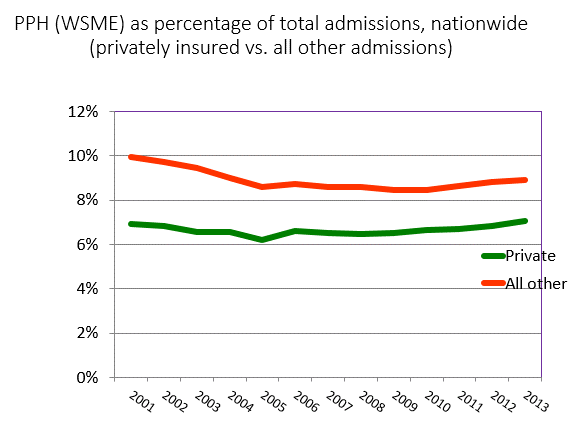
Here’s what the national WSME rate looks like. (I think there was a reporting or transcribing error by one of the reporting states in 2005-2006, to the extent anyone noticed the inflection in the graph, or cares.) This graph of WSMEs shows that, over the decade+ period of the greatest growth of workplace wellness, that there was no improvement in event rates relative to the US population that would not have had access to workplace wellness — Medicare, Medicaid and the uninsured. Obviously their raw rates were higher. This is a difference-of-differences analysis.
Quite the contrary, it appears that if anything the employer-insured cohort trended worse than the control.
Tallying this rate requires our data extraction algorithm to collect ER and IP events primary-coded both to the disease in question, or else are common complications of the disease in question. We pick common complications based on two factors:
- How likely is someone with the disease in question to get the complication?
- How likely is it that the complication in question occurs in someone with the disease?
Remember, we only tally primary codes because we want to simplify the analysis enough that we can be 100% sure of comparability between any given payor and other payors comprising the benchmark. So we look for an “80-20 rule” in what we include in the primary code data extraction.
Our diabetes rate includes quite a number of complications that fit that description., one of which is cellulitis. Diabetics are much more likely than non-diabetics to get cellulitis in their extremities — feet in particular — because they often can’t feel a cut. (Also the skin on their feet can be thinner than it should be.) Likewise, cellulitis of extremities is much more likely to be diagnosed in diabetics than non-diabetics.
If you can’t feel it, you won’t treat it. And therefore your odds of cellulitis in your foot are high. However, cellulitis in non-extremities would correlate much more loosely with diabetes, since diabetics can still feel and see skin issues elsewhere on their bodies. Therefore, not all cellulitis codes, by a longshot, are included in our analysis.
While we included cellulitis of the foot (and leg, also common enough), we somehow — despite having done these analyses 20 to 30 times a year for 15 years — omitted cellulitis of the toes. Sort of like the Matisse painting hanging upside down in the Museum of Modern Art for 47 days, no one else noticed either. Yet even the most intellectually challenged members of the wellness industry’s self-anointed awards committee understand the anatomical fact that, technically speaking, the toe is part of the foot.
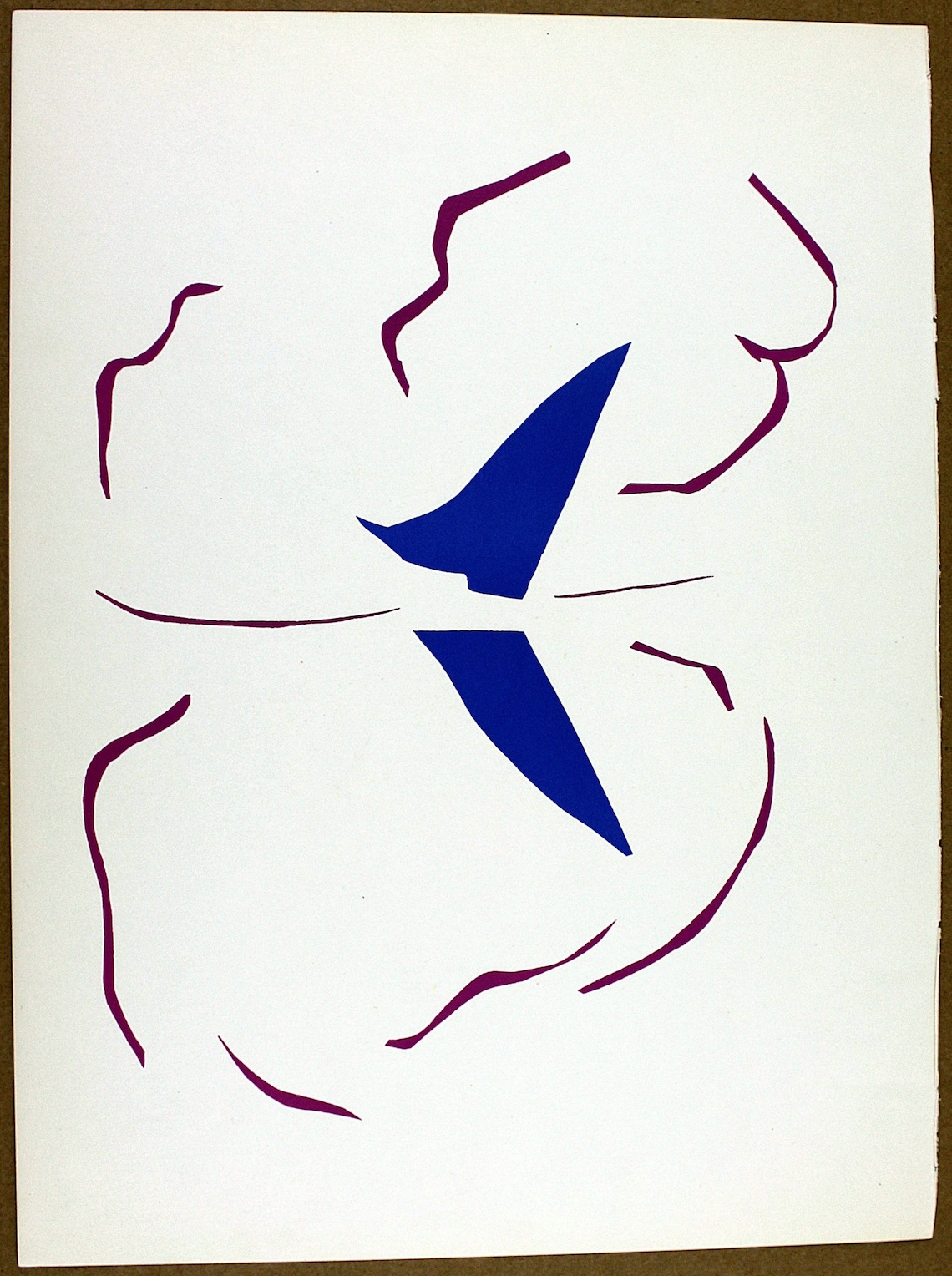
Le Bateau, Henri Matisse
Honestly, when all is said and done, this won’t change anyone’s results much, and all the changes will be in the same direction vs. history (which is also going to be recoded) and vs. the benchmark/average, likewise recoded. This is especially true in the working-age population, which comprises most of our analysis. Nonetheless, kudos to Tom Milam for becoming the third member of this most exclusive club.
*Your chances of joining this club are quite remote, statisically speaking. They are even more remote if you didn’t notice the arithmetic error just now. n increase in membership from 2 to 3 is a 50% increase, not a 33% increase. And the painting is still upside down…
Share this:

Doctor, Doctor, Give Me the News: Ron Goetzel’s latest sleight-of-hand
Looks like, to paraphrase the immortal words of the great philosopher Robert Palmer, he has a bad case of lying to you.
What has he doctored this time, you might ask?
More like, what has he re-doctored. Longtime TSW fans will recognize the first part of this posting, but stick with it. There is a sequel.
First, he put out a doctored savings claimed for one of his friends, Health Fitness Corp. HFC had pretended to save massive amounts of money for Eastman Chemical, and Eastman Chemical pretended to believe them.

This slide was re-presented many times, often in a more readable format, including the lie reproduced below in larger print. that two years of savings predating the program should be attibuted to the program.
The 2007-2008 savings couldn’t be due to the program either, not just because the risk factors hardly budged (-3%, excluding dropouts), but because Ron himself said that it takes 2-3 years even to achieve a tiny reduction in risk, which of course in turn takes many more years to achieve a tiny reduction in cost.

Obviously, if the program didn’t start for 2 years after separating the participants and the non-participants, they can’t claim savings for the participants before there was even a program to participate in. Citing savings from nonexistent programs is a wellness industry tradition, starting with Safeway’s program. That was the one which formed the basis for the Affordable Care Act’s wellness incentive.
So every penny of alleged savings prior to 2006 was due to the study design rather than the program itself. It subsequently turned out that comparing participants to non-participants was completely invalid. I proved it using the wellness industry’s own data, and then two randomized control trials showed the exact same thing. Zero risk reduction attributable to the intervention.
So what did Ron do when it was pointed out that you can’t claim savings for a program that doesn’t exist? Nothing, at first. Then The Incidental Economist (TIE) got wind of Ron’s analysis and called it, to use their technical term, “crap.”
TIE is widely read, so Ron had to do something. Ron’s response was to call the graph “unfortunately mislabeled, using the passive voice, as though the graph reproduced itself.
He then doctored it, whiting out the labels altogether, yielding this rather sparse x-axis.
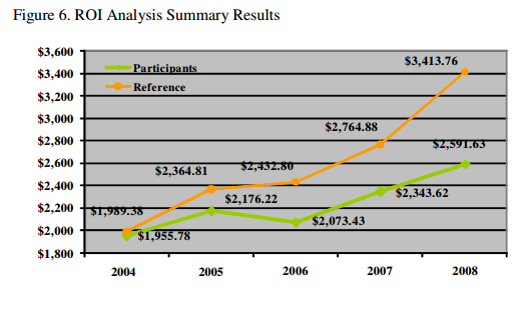
He then duly published an “erratum” — that’s Goetzel-speak for admitting you got caught — in the Koop Award application: Ron is affectionately known as “Goetzel the Pretzel” for the prowess he has achieved, honed by years of experience, in making lies sound like innocent mistakes, or “errata.” This one is a screenshot as it appears today on the site, and I just emailed it to myself so Ron, don’t even think of “disappearing” the evidence, as is your wont…

Hmmm…nothing in the active voice about who was responsible for this “mistake.” Perhaps the erratum just wrote itself.
And that brings us to Ron’s most recent sleight-of-hand, which is why a 10-year-old slide is back in the news. He recently re-doctored the original doctored savings slide, which now once again resides on the Koop Award website, along with the aforementioned “erratum” which he forgot to delete when he replaced the original phony savings slide with the doctored version of the phony savings slide (which is apparently now also compliant with “HIPPA”). Try reading that again — tough to keep up with all the deception.
Hmm…looks like the erratum needs an erratum because the original X-axis is back.
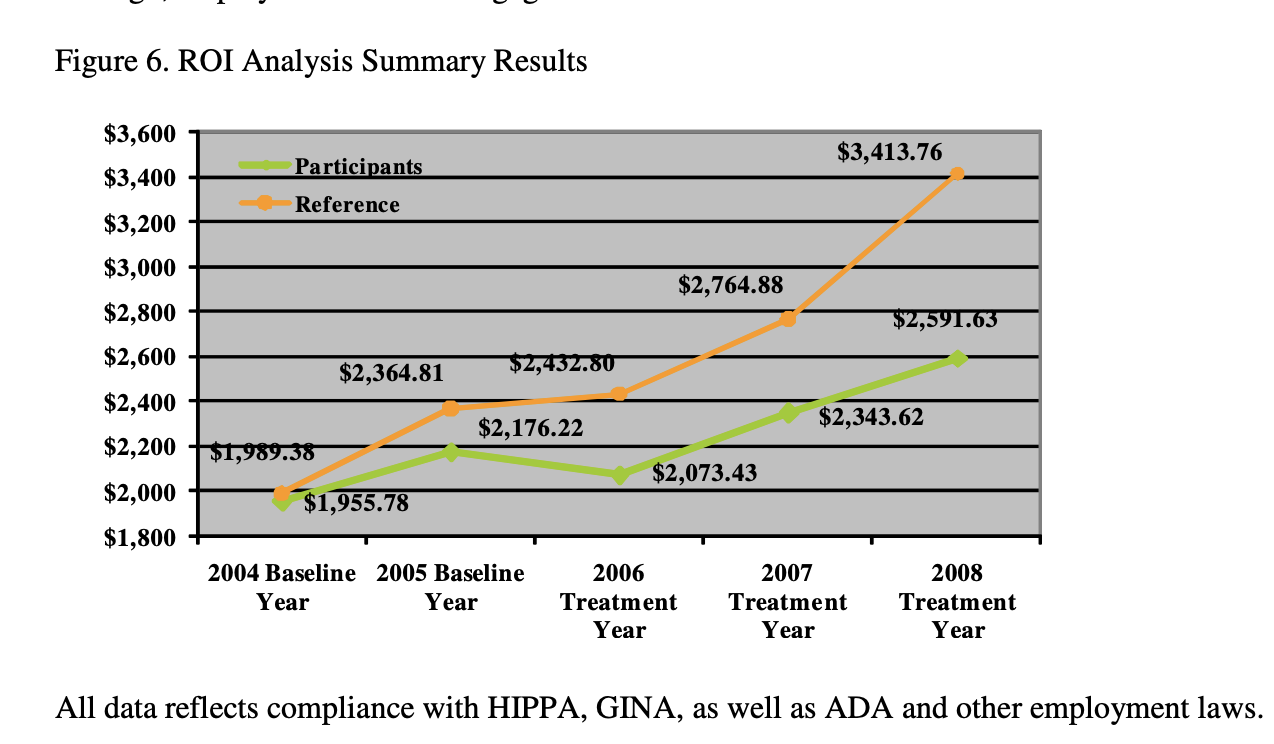
Why did he recently re-post the original slide? One of two reasons:
- In a fit of conscience, he realized his new lies were wrong and replaced them with his old lies;
- The people he worked with at Eastman Chemical and HFC were told by someone — I don’t know who and shame on them! — that he had doctored the original. They insisted on changing it back because indeed the program did not start until 2006.
Either way, we look forward to hearing Ron’s rebuttal. After all, this blog posting isn’t going to rebut itself.
Share this:


What a smoky bar teaches about COVID transmission
it’s rare that we use this blog to simply point you to something that:
- we had nothing to do with,
- is better than anything we could have come up with…
…but we’re doing exactly that today. This is the best explanation of airborne COVID transmission I’ve ever seen. Special thanks to Dr. Anthony Pearson of The Skeptical Cardiologist for bringing it to our attention.
Think of smoke as COVID viruses. Just like smoke is suspended in the air, so are virus particles. In both cases, there is no magic in being 6 feet from the source. The 6-foot distancing rule is more like an “80-20 rule” of distancing. It’s not an invisible barrier.
If one person smokes in a bar, basically everyone in the bar can smell a little smoke. Obviously, the patrons sitting closer to the smoker smell more. Likewise with one COVID superspreader in an indoor space.
Outdoor spaces are different. Someone can smoke downwind from you or X number of feet away with no wind…and you won’t even notice. But you don’t want to be surrounded by smokers or upwind from them.

Connect here to go the The Conversation and read the entire analogy. And why we think it’s the best way to describe COVID transmission.
Fortunately, Quizzify has question sets addressing this exact topic. So contact mark@quizzify.com today to see how you can get access.
Share this:


Are you wearing the wrong mask?

New research shows two popular masks are probably worse than none at all.
This research was conducted by a team of researchers at Duke University, including a professor of physics, chemistry, radiology and also biomedical engineering, the type of guy you would have wanted on your side last time you played Trivial Pursuit against a team of Nobel Prizewinners.
For a second opinion, join our webinar August 25th at 1 PM EDT, featuring COVID Uber-Expert Dr Ian Lipkin (yes, the same Dr. Ian Lipkin you’ve seen on every major network in th last few months), in a virtual open-mike Q&A session covering this and every other COVID-related topic.
First, the good news. The tried-and-true disposable surgical mask is indeed effective. Those little blue ones that you hook to your ears do the job. 100,000 surgeons can’t be wrong.
Not all the mask news is good, though. At least one popular design turns out to be worse than no mask at all.
To read more, visit the latest blog post on Quizzify.
Since you’ve probably already clicked through once, from Linkedin, I’m not gonna make you click through again to Quizzify. I’ll just give you the answer. It’s those “neck gaiters” favored by runners. The reason I’m not simply repeating the entire Quizzify blog post here is that you can’t just copy-and-paste a blog post. You have to re-upload all the images in a multistep process for each image. Life is too short.
Got more questions? Join that webinar on August 25th! Get your questions in early to Mark@quizzify.com to make sure they get answered.
Share this:


8/25 Webinar featuring #1 COVID expert not named Fauci

You’ve maybe read about him, or seen him remotely, many times, on both Fox and MSNBC (yes, both), as well as CNN, CNBC, CBS, NBC, and even the BBC. Now is your chance to ask your questions live, directly to Dr. Ian Lipkin, John Snow Professor of Epidemiology at Columbia University.
The webinar will be held 8/25 (Tuesday) at 1 PM EDT.
Dr. Lipkin, who has warned about the pandemic hazard potential of “wet markets” for many years, has first-hand knowledge of the origin, development of vaccines, and, of course, all the information and misinformation surrounding COVID.
As reported in USA Today, he also got the virus himself in March. (“If it can happen to me, it can happen to anyone.”) So in the immortal words of the great philosopher Judy Collins, he can look at COVID from both sides now.

This webinar will feature a few minutes of prepared remarks, along with 5 test-your-knowledge-of-COVID questions…and otherwise it’ll be the webinar equivalent of open-mike night. Dr. Lipkin will answer as many questions as we can squeeze in. So register early, and (while questions will be taken live too, time permitting) get your questions in early, to Mark@quizzify.com.
Share this:

PBMs: The “Tapeworm” Revealed
Warren Buffett famously said that medical spending was the “tapeworm” of the American economy. Many a tree has been killed demonstrating this point, but there has never been a single one-page image that would sear it into everyone’s mind, and rally the entire employer community behind the idea that there has to be a better way.
Until now. Here it is.
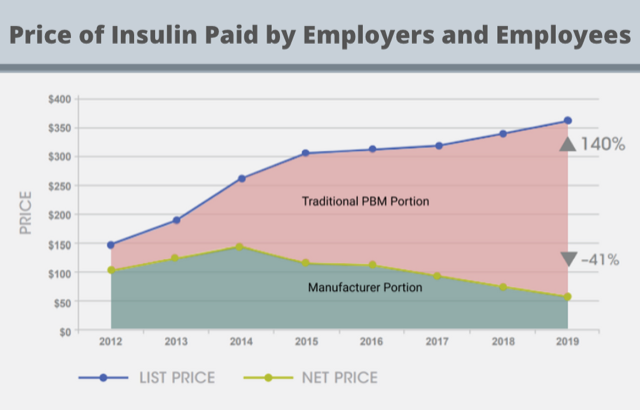
Source: Buried in something called Drug Channels.
There may be a few buyers who have generic insulin on the formulary, but there are plenty that don’t:

There you have it: the shock-the-conscience unveiling of the Tapeworm (the pink), as far as drugs are concerned. This is just one drug, but this process likely repeats many many times for many generic drugs. How is it that the process of distributing a drug and tracking who buys it sucks up much more of the value chain than actually making it?
How is it that the price paid of a container of generic Ambien can range from $3.25 (Drexi) to $136 (CVS)?


Speaking of scams…
Don’t get us started on wellness.
Balance (surprise) billing is Quizzify’s favorite scam.

Even though, according to the New York Times and others, we actually solved the problem (for non-elective surprise bills), most employers — like with PBM markups — don’t realize they have a problem in the first place. They are simply picking up most of the tab without noticing something amiss. Sort of like ET hiding in the stuffed animals.

Crooked PBMs, wellness vendors and providers…
The problem is that, for all the complaints about spending, employers how easy it is to solve these problems. Alternatives to PBMs are easy to come by. And swap out wellness for Quizzify, and put the Quizzify surprise billing language on every insurance card.

Share this:

Court-ordered 2021 EEOC wellness rules: an existential threat or huge opportunity?
The EEOC has published rules in draft form. They still need review by the Office of Managment and Budget, but that’s just a formality.
Incentives need to be cut back to “de minimis” for participation-based programs…but there is a way around the court ruling for those highly popular and effective (not!) outcomes-based programs.
Since the EEOC is basically pro-business these days, they have managed to circumvent the spirit of Judge Bates’ December 2017 decision, without violating the letter, and employers will be able to subject employees to fines of thousands of dollars starting in January.
However, it increasingly appears that outcomes-based programs, while arguably complying with the new rules regarding the Americans with Disabilities Act, violate the Affordable Care Act, because (with the well-documented, Validation Institute-validated exception of US Preventive Medicine), they fall short of the ACA’s standard of being “reasonably designed to reduce risk or prevent disease.” Just too many epic fails, all documented on this blog, including Koop award winners like Wellsteps, arguably the industry’s worst program now that Intereactive Health has gone bankrupt. (Ironically, it is also among the best-documented programs. Why they published their own self-immolation is anyone’s guess.)
Fortunately, there is a solution allowing you to maintain your existing incentive structure next year, and significantly reduce the cost while improving the performance of your program…and we will be covering it on Thursday at 1 PM ED. Register here.
PS Admit this is the first you are hearing of these new rules. And yet they are pretty close to a done deal in practice, even though the public can still comment soon. Good luck with that.

 They Said What?