
Blog

Journal of the American Medical Association on the Harms of Overscreening
They Said What has always noted the complete and utter worthlessness of screening the stuffing out of employees. The wellness vendor response to this observation? To double down on overscreening. One recalls the immortal words of the great philosopher Inspector Louis Renault: “Owing to the seriousness of this crime, I’ve instructed my men to round up twice the number of usual suspects.”

Here is one such vendor, the lucky recipient of a follow-up profile to be published next month.
Their litany of tests before my initial observations about their overscreening were published:

Their current roster of tests, setting a new wellness industry record:

However amusing it may be to remark on the rampant epidemic of very stable genius-itis in the wellness industry (and it is), screening the stuffing out of employees is no laughing matter. It is harmful. Here is the current Journal of the American Medical Association on the harms of screening. Unfortunately the entire article is behind a paywall, but the abstract basically highlights the wellness industry business model:
Overused tests and treatments and resultant downstream services generate 6 domains of negative consequences for patients: physical, psychological, social, financial, treatment burden, and dissatisfaction with health care. Negative consequences can result from overused services and from downstream services; they can also trigger further downstream services that in turn can lead to more negative consequences, in an ongoing feedback loop.
This is of course exactly what hyperdiagnosis is all about — and the poster child for hyperdiagnosis is none other than the winner of the 2017 Deplorables Award, Interactive Health. A single Interactive Health display captures it all, the breathless braggadocio about sending employees to the doctor because they flunked one or more of the 43 tests that Interactive Health runs, with no regard for the harms that JAMA has identified:

So, in all seriousness, can we please, please stop the hyperdiagnostic madness and start screening according to the US Preventive Services Task Force guidelines?
Share this:


A Review of Netflix’ The Bleeding Edge

The wellness industry is the Maginot Line of workplace health. While wellness vendors are imploring employees to eat more broccoli, and hyperdiagnosing the stuffing out of them to find “newly discovered” conditions that are mostly false positives and harmless out-of-range readings, really bad stuff has been happening that has somehow eluded this industry’s attention. One would be the opioid epidemic, which no vendor seemed to notice. Except Optum, whose HRA basically advises employees to get more pills for their pain.

(Do you know more than Optum does about opiods Take this quiz and find out.)
The other would be the explosion of harms caused by the healthcare industry itself, and that is the subject of The Bleeding Edge, a well-received new documentary (Rotten Tomatoes rating: 89%) on Netflix. (In case anyone is keeping score at home, Quizzify is also about harms caused by the industry…and already educates employees to avoid most of what The Bleeding Edge covers.)
The Bleeding Edge follows victims of three different kinds of implants — vaginal mesh made by Johnson & Johnson, metal-on-metal hips made by Johnson & Johnson (are you seeing a trend here?), a birth control device financed in part by the current head of the FDA — along with briefer cameos for CAT scans and the DaVinci robot.
Interviews of victims of these implants (including one who started out as a spokesperson for these implants) are intertwined with surgeries and images of devices gone haywire inside the victims’ bodies, and expert talking heads about how this could be allowed to happen. (“More evidence is required to remove a device than to approve it.”) The experts are very well-credentialed and include the long-time head of the FDA, David Kessler, and bestselling author and Johns Hopkins accountability guru, Dr. Martin (“I love what Quizzify is doing”) Makary.
Perhaps the most compelling interview, though, is with the aforementioned former spokesperson for the birth control device-turned-victim advocate. Switching sides like this never happens. Most people pick a side and stay on it, facts be damned. Switching sides after seeing new facts is almost unheard of — it would be like Ron Goetzel not only admitting that wellness doesn’t work, but blowing the whistle on his friends at Wellsteps and Interactive Health.
The difference was that this spokesperson was also a customer…until her device went badly astray as well.
What is the FDA doing about this?
So what, as the film describes, is the FDA doing to put the kibosh on all this? Four things:
- Facilitating approvals of new devices on almost no evidence
- Laughing out loud on videotape at the idea that they may get in trouble because some people could get harmed
- Hiring industry executives to regulate their friends and companies they have invested in
- Firing experts who advocate for disclosures of hazards.
Yes, we know it isn’t always about Quizzify but #4 specifically relates to the hazards of CAT scans. The FDA apparently fired nine employees for advocating what we here at Quizzify have educated patients on — right on our landing page quiz — for three years: the radiation hazards of CT scans, especially repeated scans. Your doctor isn’t telling you about this risk possibly because everyone at the FDA who would have told them is gone.
Likewise, the FDA takes a hands-off approach on the DaVinci robot, another Quizzify whipping boy, though we weren’t the first to question their integrity. The FDA let the company put the robot into the hands of completely inexperienced surgeons, and multiple cases have been reported in which a woman’s insides literally fell out following the surgery.
Many doctors — especially “leading experts in the field” — get directly or indirectly compensated to use and pitch these devices. Your doctor could be one of them, and it’s not like he or she is going to volunteer the information.
What should employers do?
It seems that the only people who truly advocate for the patient are the patient and the patient’s family. Everyone else involved in the care conversation makes more money when employees buy more things on the employer’s dime. (This is not to say all providers or device manufacturers are corrupt, or anything close to that, of course. But with all this money at stake, shareholders interest and patients’ interest could be at great variance. One need only look at stock prices to see which side usually wins.)
Likely much the opposite of what they are doing now. First, stop obsessing with screens and risk assessments. Prying, poking and prodding doesn’t work, so get over it. Start focusing on things that matter, like the harms described in this film and like what Atul Gawande says:
Virtually every family in the country, the research indicates, has been subject to overtesting and overtreatment in one form or another. The costs appear to take thousands of dollars out of the paychecks of every household each year…Millions of people are receiving drugs that aren’t helping them, operations that aren’t going to make them better, and scans and tests that do nothing beneficial for them, and often cause harm.
At the very least, employers should slow down before encouraging the opposite, incentivizing employees to use lower-cost settings to get things that they may not need, and may even harm them. Obviously (with the exception of childbirth, which is going to happen anyway), removing the economic disincentive to get more stuff means people will get more stuff.
Instead, educate your employees, using Quizzify or some other tool like Quizzify (good luck finding one), that, as we say at Quizzify and as anyone who watches The Bleeding Edge will say:
Just because it’s healthcare doesn’t mean it’s good for you.

Share this:


Extensive Wellness Industry Expose Reaches Popularity Milestone
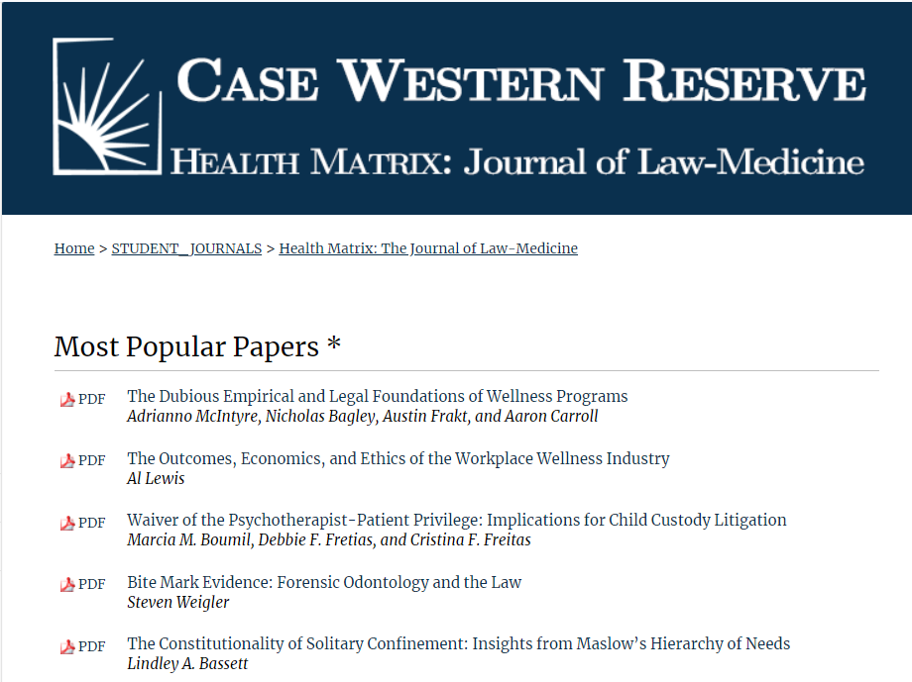
The most comprehensive expose of the “pry, poke and prod” industry is likely to have broken the 1000-download threshold by the time you read this.

Published by the leading law-medicine journal, it is their second-most-popular paper of all time. Curiously, while this is the oldest law-medicine journal in the country and has covered a multitude of topics over many decades, the most popular paper of all time is also a smackdown of pry, poke and prod programs.
Because TSW doesn’t lie (that’s part of the reason we are so unpopular amongst the HERO crowd and its sycophants), I would acknowledge that the methodology they use to measure popularity favors more recently published articles, and ours is “only” a year old. Even so it is quite a feat because, while we are close on the feels of #1, there is a big gap between us and the #3 article.
In the structured world of law, as opposed to the “Wild West” of wellness, there are rules. That’s why I chose the leading law-medicine venue for this expose.
One rule of evidence is that some of the best evidence — one of the few exceptions to the hearsay exclusion — is what’s known as an “admission against interest.” An admission against interest is “a statement by a party that, when uttered, is against the party’s pecuniary, proprietary, or penal interest.” It’s even more compelling if it is captured electronically, as on a live mic, or in print.
The best example is Robert Durst accidentally admitting that he killed his wife during a bathroom break while being interviewed for a documentary, when he was still miked. You’d have to be, as Larry David might say, pretty pretty pretty pretty stupid to make admissions against interest when you are miked or in print.
One would think.
And yet the wellness industry’s entire modus operandi is to do exactly that. All that remains is for someone like me to point these things out, take a screen shot (the equivalent of Durst being miked), and then sit back, make some popcorn, and watch them react. Reacting is also a form of evidence. Reacting the way a guilty person would react is prima facie evidence of guilt. (To use the examples from the TSW landing page, think OJ and the white Bronco or Lance Armstrong and just about anything he said or did after being accused.)
Needless to say, the wellness industry’s very stable geniuses never step out of character when it comes to guilty reactions. This runs the gamut. Sometimes, as with Bravo, they pull down the incriminating screenshot immediately after being outed. Or, as with Interactive Health, they simply excise the incriminating data from their “research report” and call it a “research summary.” (And also they try to bribe me not to talk about them any more. I’m just sayin’…)
Or, as with Wellsteps, they act out with unsupported and creatively spelled recriminations.

Or sometimes simply trying to erase history. This is the specialty of Ron “The Pretzel” Goetzel, twisting and turning his words to do exactly that, not realizing that we keep screenshots. Here is the “before” and “after” picture of him erasing the smoking-gun evidence that a program’s “impact” was due entirely to separation into participants-vs-non-participants rather than pry, poke and prod. Note that from 2004 to 2006, separation between participants and non-participants increased almost 20% — before there was even a program to participate in.
Before (what really happened):

In order to maintain the fiction that participants-vs-non-participants is a valid study design, Ron simply removed the labels from the x-axis:
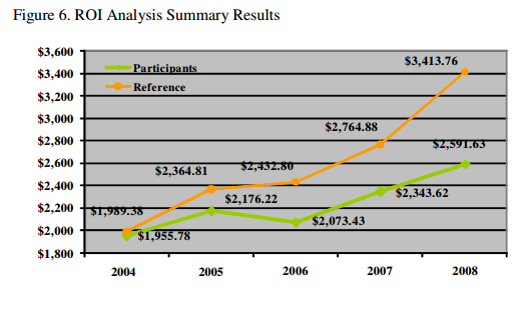
Lest anyone domiciled in a state where marijuana is now legal think the first one was a mistake and was corrected as soon as they noticed, they actually repeatedly reprinted and reused the original in many forums, like this one:

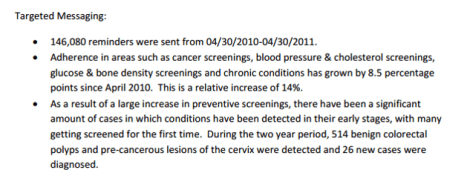
Sometimes, and this was my favorite of Ron “The Pretzel” Goetzel’s twists and turns, he literally rewrote history, in the form of forging a letter from the Governor of Nebraska, once he admitted the initial claim of saving the lives of 514 cancer victims was exposed as a fraud:
Original:

Doctored:
Here is your assignment: pass this along to everyone you know and ask them to read the article. Then hopefully it will be time to write the history of wellness the way it should be written. And keep a screenshot in case Goetzel tries to rewrite it.
Share this:


Wellness vendors foresee “Wild West of Litigation” in 2019
Four of the most stable genius vendors in the wellness industry have penned a letter to Montana’s junior senator, in which their usual wellness savings propaganda — contrary to all evidence, of course — ends with a plea to confirm EEOC appointees who they hope will institute new rules by January designed to allow them to continue to harass employees in order to enhance their own revenue streams.
Being wellness vendors, naturally they got the facts wrong. Even if a new chairperson were appointed, the EEOC has already said it won’t issue rules by January. Besides, the idea of just adding a staff member and then immediately issuing rules is ludicrous. Anyone with any insight into how the rulemaking process works knows that’s not how the rulemaking process works.

Facts and insights are two of the many things wellness vendors have trouble comprehending, along with data, integrity, math, and — as we’ll see below — irony. (And, also, as we’ll see below, wellness.)
Their specific language:
Without clear guidance from the EEOC, we fear a Wild West of litigation could re-emerge as did it prior to the EEOC guidelines…jeopardizing programs that are improving the health of America’s workforce.
For months, we have been urging companies to take an obvious and painless step — requiring no government regulation or intervention or plaintive pleas to seemingly random junior senators from seemingly random states — to insulate themselves from this pending “Wild West” litigation.
Specifically, by offering alternative vendors such as Quizzify to indemnify themselves from this possibility, employees save money immediately and educate employees at the same time they avoid liability.
Having to offer Quizzify would be these vendors’ worst nightmare (since most employees would much rather learn something useful than be screened and told to eat more broccoli), and yet the letter’s four signatories are probably the four vendors most likely to be sued by employees if they don’t offer Quizzify as an alternative. Let’s look at each in turn.
Bravo Wellness
Bravo is the only vendor in the wellness industry to publicly brag about how much “immediate employer cost savings” can be obtained by fining employees who decline to have the stuffing screened out of them in violation of all US Preventive Services Task Force guidelines. Of course, Bravo’s program itself saves no money according to its own findings. There is also a question about their financial solvency, since they apparently can’t afford an internet connection.

Health Fitness Corporation

Health Fitness Corporation (HFC) bragged incessantly about its “life-saving, cost-saving catches” of 514 Nebraska state employees who had cancer. This was fairly easy to accomplish because it turned out, as HFC later admitted that they didn’t have cancer in the first place. (Ron Goetzel kindly forged a portion of a letter from Nebraska’s Governor to replace the old braggadocio with the new admission. I have to give him credit for loyalty here. He was willing to risk a felony charge in order to support his friends.)
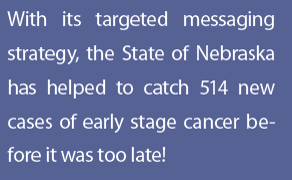
Bragging about how many sick employees they hyperdiagnose is a pillar of the wellness industry. In this case, HFC found all these false positives likely because they “waived” screening guidelines so that anyone of any age could get a colonoscopy, and sent out solicitations featuring a model way too young to be indicated for one.
“Waiving” screening guidelines is the wellness industry equivalent of “waiving” the minimum age requirement for a driver’s license. Fortunately for the very stable geniuses in the wellness industry, there is no regulation requiring wellness vendors to understand what they are doing, and they take full advantage of that loophole.

HFC also saved 20% on a wellness program with Eastman Chemical. This was also quite easy to accomplish because it turned out they didn’t even actually have to implement the program. Simply splitting the group into participants and non-participants did the trick. As you can see from their Koop Award application below, the program already “saved” about 20% between 2004 and 2006 during the baseline period, before they started giving employees the aptly named “treatment.”
The Incidental Economist was very impressed with this study design. (Not!) But I’ll tell you who really was impressed: Ron Goetzel. He gave HFC Koop Awards for both studies. For those who are not familiar with the it, the Koop Award recognizes the most stable geniuses in the wellness industry who are also sponsors of the Koop Award.

Wellness Corporate Solutions

Along with whining about how “shrill” I am (examples being…?), Wellness Corporate Solutions is worth “siting” (add English to the list of things wellness vendors don’t understand) for its crash-dieting contests, in which employees binge and then starve themselves to win prizes. Lately they’ve added a new twist: water-drinking contests. Obviously the first is bad for you. Overhydration turns out to be a bad idea. It doesn’t exactly enhance your productivity, if you catch my drift. Oh, yeah, and you also have to make sure you don’t die.

Viverae
Viverae may or may not harm employees. Obviously it fabricates its savings (claiming a $739/employee savings on a health score improvement of 2.4% creates an industry-leading Wishful Thinking Multiplier of 307), but catching a vendor lying is dog-bites-man in this industry. The more amusing thing is their “savings guarantee” which, this being the wellness industry, doesn’t guarantee savings for many reasons, not the least of which is there are none. You also have to “require” employees to submit to screens. No wonder they are worried about being sued.

Here is a guarantee of my own: I guarantee (and will put all consulting fees at risk) that I can prove that if Viverae says you saved anything, you didn’t.
Here’s another guarantee: while hiring these wellness vendors may very well get you sued, this one flyer (plus the Quizzify indemnification) will prevent that from happening.

Share this:


The evil genius of Arkansas’ teacher wellness program
Arkansas recently contracted with an out-of-state vendor called Catapult Health to come in to the state’s schools and “play doctor” with the teachers, asking them personal questions, taking their blood and then telling them everything that’s wrong with them. This is a classic example of a “pry, poke and prod” program.
This is followed by admonishments to take more steps and eat more broccoli. They then refer teachers into lifestyle and disease management programs “at record rates.”
Sounds terrible, but the good news is that this program isn’t going to cost taxpayers anything because, as Catapult Health’s website says:

Phew! At least it’s free to taxpayers because Catapult’s expenses and profits are “already in your budget” and “fees are processed through your health plan.”
Except that the state of Arkansas is its own health plan. There is no “Don’t worry. Insurance will pay for it” here. The state is self-insured, meaning they pick up the tab, not some nameless insurance company.
But, hey, at least this program will save money, right?
The return-on-investment for the state is allegedly 3.27-to-1, as shown by the so-called “Harvard Study,” conducted by Katherine Baicker.
Except that the Harvard study has been proven wrong, not just by the nonprofit, nonpartisan highly respected RAND Corporation (and I myself chimed in as well), but by an ace researcher named Damon Jones, part of the prestigious National Bureau for Economic Research. His work showed that wellness accomplishes virtually nothing other than the expenditure of money. (Don’t worry—insurance will pay for it.)
But, hey, maybe Prof. Jones is wrong. After all, why should he care what Prof. Baicker thinks, right?
Um, because he reports to her? Yep, he’s an associate professor at the exact same school of public health where she is now dean. Just guessing here, but it would seem a subordinate would have to be pretty darn sure of his findings (and they are rock solid, and completely in agreement with all the other recent research, summarized here) to publicly humiliate his own dean.
Even Prof. Baicker doesn’t defend her findings any more. She says: “It’s too early to tell.” That means she is running away from her very widely cited signature study, upon which essentially the entire wellness industry’s economic justification is based. This would be like Arthur Laffer, whose Laffer Curve created supply-side economics, which has been used to justify two tax cuts, saying “well, maybe it’s not right. I dunno. Let’s wait and see.”
But, hey, at least forced wellness improves employee health, right?
Apparently not. Forcing people to get annual wellness checkups doesn’t benefit them, according to the New York Times, the New England Journal of Medicine, the Journal of the American Medical Association, and Consumer Reports. (Before dismissing the credibility of those sources due to possible political bias, keep in mind that Newsmax, The Federalist, and Laura Ingraham hate “pry, poke and prod” programs too.)
Forced wellness also takes teachers away from the classrooms to be pried, poked and prodded, stresses them out, and adversely impacts morale.
Further, sending “record rates” of employees into lifestyle and disease management is classic hyperdiagnosis – braggadocio-fueled misunderstandings of the arithmetic of lab results, resulting in large numbers of people getting told they need coaching and care they don’t want or, in general, need. Nothing makes a wellness vendor happier than to hyperdiagnose as many employees as possible.
But, hey, maybe teachers are a special case. Maybe the impact of “pry, poke and prod” programs is different for them?
It sure is. The single school district for which the data has been compiled is Boise, Idaho. According to the wellness vendor’s own data, the health of the teachers got somewhat worse as a result of this pry, poke and prod program. (The vendor, an outfit called Wellsteps, also admitted that they flouted clinical guidelines and fabricated their only positive outcome. They also previously admitted that costs went way up as a result of their program. They later suppressed that admission. Wellness vendors are not known for their integrity.)
So the health of teachers may deteriorate, creating more medical expense. but don’t worry. Insurance will pay for it.
But, hey, at least the teachers like it, right?
According to Catapult, employees love them. Ask the employees and you might get a different impression. indeed, I was tipped off to this program by an Arkansas teacher who hates it, like most of her colleagues do — and that’s before they learn that they are actually paying for it…keep reading.
Obviously if teachers wanted to submit to a “pry, poke and prod” program, the state wouldn’t have to threaten them with massive fines – almost $1000/year, which appears to be close to a record for any pry, poke and prod program anywhere — for refusing to let a private, out-of-state corporation play doctor on them at state expense.
But, hey, at least the state taxpayers save money by fining the teachers who don’t want to play doctor, right?
Actually, wellness makes claims costs go up, probably by more than the fines. There are lots of unneeded lab tests and other tests. For instance, the state of Connecticut admitted that in addition to throwing away all its money on the actual wellness program, they spent more on health care. The state comptroller who administered the program said the increased spending was “a good thing.” I guess he wasn’t worried because insurance was paying for it.
But, hey, at least the teachers don’t pay for it.
Actually they do. The state’s human resources department brilliantly figured out that they could launder their wellness spending by hiring this outfit. By paying extra to Catapult (a multiple of what an effective wellness program would cost), the state is able to pick up the tab for wellness using the extra paperwork of a medical claim, as opposed to an outsized administrative expense in a separate line item. The latter would clearly need to be picked up by the taxpayers…and the state would have an incentive to control this highly visible figure.
By contrast, paying for “pry, poke and prod” as a medical claim will never be noticed, like Steve McQueen and David McCallum sprinkling the dirt from the tunnel around the stalag. On the other hand, it will increase overall medical spending by 2-3% (the cost of the screening plus the added hyperdiagnosis expenses).

Here comes the evil genius part: at the next contract negotiation, the state can limit wage increases (or reduce benefits) by pointing out how high the health spending is.
So the teachers get pried, poked and prodded, hyperdiagnosed with hidden illnesses most of them don’t have – all against their will…and then they have to pay for the privilege in reduced wages.
Wow…the teachers are getting screwed. But, hey, at least they can’t sue the state, right, so taxpayers won’t have to pick up that bill as well?
Starting in January, this program will be in blatant violation of two laws, the Americans with Disabilities Act and the Genetic Information Non-Discrimination Act. Those laws disallow forced wellness checkups, but allow so-called “voluntary” ones.
Until recently, “voluntary” meant “do wellness or pay a big fine” like this one. But thanks to a lawsuit by AARP, the rules are changing in January so that “voluntary” must mean voluntary, like a dictionary would define the word. (This summary has the links to all you need to know about the case.) To get these fines back, teachers will be able to sue the state, possibly even as a class action, and possibly being awarded punitive damages. Exposure to lawsuits could cost the state millions more in addition to its current expenditure on Catapult Health.
And that doesn’t even cover the costs of a possible teacher walkout, like the one in West Virginia that was spurred in part by – you guessed it – their wellness program.
But, don’t worry. Insurance will pay for it.
Share this:


BenefitsPro urges employers to take action now on 2019 wellness rule change
In the immortal words of the great philosopher Yogi Berra, it’s tough to make predictions, especially about the future.

However, in this case the future is pretty easy to predict: The EEOC “Safe Harbor” for clinical wellness programs ends in less than 6 months, period. Time is running out in the race to put non-clinical options in place in 2018 (to drive the 2019 premium differential)…and yet many employers, thanks to the obfuscation of their “pry, poke and prod” vendors, don’t even realize the race is on.
Problem is, too many employers listen to their wellness vendors, who largely seem to be missing the gravity of this situation altogether. Mind you, these are the same very stable geniuses who also managed to miss the rehabilitation of eggs, fats, and dietary cholesterol, the entire opioids epidemic, and the part of fifth grade where the teacher explained that a number can’t go up and down at the same time. So naturally they are on track to miss the biggest wellness event since the passage of the Affordable Care Act.
By contrast, the most recent BenefitsPro just devoted its lead article to this impending event. Main takeaways:
- Employers are “not likely” (that’s an understatement) to see EEOC rules allowing a safe harbor to be put in place for 2019, and therefore they are “in limbo.”
- “Should employers continue with current programs, considering the risk of EEOC enforcement or private legal action, or should affected employers come up with a plan B?”
- Plan B should include “indemnification options” by vendors such as…hmmm…let’s take a looksee at who they recommend…ah! Quizzify.
- Screening doesn’t work anyway, so why do it when it could just create liability absent that indemnification?
There is, they added, some further urgency because “it’s unclear whether safe harbor protection will be removed from 2019 premium differentials based on 2018 screenings, or only based on 2019 screenings and health reimbursement accounts.” In other words, you need to get your screening-alternative plan in place now, or else you may lose the entire premium differential in 2019. (Meaning an employee can obtain the best health plan option even if he/she refuses to be screened in 2018 and you didn’t offer Quizzify as an alternative, to render the screening voluntary.)
Of course, as in every other article about the EEOC rules, it is de rigueur to quote a screening vendor urging employers to keep their heads firmly anchored in the sand. In this case, the quoted vendor is urging employers to “continue to be compliant with the existing regulatory environment and monitor developments.” (At least this is better than Bravo, which accused us of spreading “rumors, chatter and fiction” about the 2018 sunsetting. Our crime? The same as usual in wellness: we were honest and accurate, two adjectives that could never be applied to most wellness vendors.)
The problem with this quoted vendor’s sentiment? There are no “developments” left to “monitor.” The EEOC has already said what it intends to do to preserve the employer safe harbor in 2019 (nothing), leaving employers who want a safe harbor no alternative other than to seek indemnification, such as Quizzify’s.
Therefore, regardless of what screening vendors want you to do (which is more screening, surprisingly), learn what is certain to happen in 2019. Otherwise you’re flying blind. And in the immortal words once again of Yogi Berra, if you don’t know where you’re going, you’ll end up someplace else.
Share this:

Congratulations to Amazon/Berkshire/JP Morgan on an excellent choice
The announcement of Dr. Atul Gawande as the head of this joint venture means they’ll be ending their pry, poke and prod programs — and instead focus on exactly the type of thing Quizzify does. Here is Dr. Gawande’s exact quote:
Virtually every family in the country, the research indicates, has been subject to overtesting and overtreatment in one form or another. The costs appear to take thousands of dollars out of the paychecks of every household each year…Millions of people are receiving drugs that aren’t helping them, operations that aren’t going to make them better, and scans and tests that do nothing beneficial for them, and often cause harm.
in other words, the biggest problem among the workforce is a health literacy deficit, not a broccoli deficit. If there is one thing health literacy courses teach, it’s this: Just because it’s healthcare doesn’t mean it’s good for you.
Share this:


The Workplace Wellness Industry’s Body-Shaming Hall of Shame
Note that this personal blog post does not necessarily represent the views of any organization with which I am affiliated, other than the one with which I co-founded. I am referring, of course, to the Needham Frisbee Club, where everyone is welcome to join and play and become fitter — since fitness at any size, not corporate crash-dieting contests, is the key to health.
By now, many facts are well-known about weight and weight loss programs:
- Variations in body size do not correlate with variations in willpower
- No one really knows why the country has gotten fatter since 1986, reversing the trend through 1985, and without understanding the causes of this fairly sudden reversal, it’s not possible to address it. (We do know that the lowering of cutoffs in 1989 created an additional 30 million “overweight” people in the U.S. overnight. http://www.cnn.com/HEALTH/9806/17/weight.guidelines/)
- It is much better to be “fit and fat” than to try to diet your way to health
- The vast majority of people who lose weight gain it back
- 1/3 to 2/3 gain back more than they lose
- No wellness vendor has discovered the secret to weight loss that has eluded researchers for decades
- The often quoted 90-95% failure rate of programs is likely underestimated.
Further, while perhaps not proven, there is growing evidence, also here, and here, that weight cycling may be hazardous to health. (This would likely be particularly true when an employer ties incentives to gaining weight for the first weigh-in in order to lose it by the second weigh-in.)
And, yet, a number of the workplace wellness industry’s very stable geniuses have chosen to body-shame employees. The individuals and companies listed below are the wellness industry’s leading body-shamers, charter members of the Body-Shaming Hall of Shame. No surprise that wellness luminaries are leading the charge towards body-shaming, as their industry has repeatedly been called words like “sham” and “scam” by Pulitzer Prize-winning media outlets not otherwise known for name-calling.
Where possible, we have provided contact information, that you can use to let the appropriate people know how you feel about endorsing body-shaming in the workplace. Obviously, one can never eliminate discrimination based on body type, but hopefully this exposé, and creating the Body Shaming Hall of Fame, will reverse the trend towards employer support of weight discrimination in wellness programs.
Troy Adams, Wellsteps
Wellsteps is known in general for harming employees, and won a Deplorables Award in 2016 for harassing Boise School District employees. Mr. Adams cemented his and Wellsteps’ candidacy for this list by declaring: “It’s fun to get fat. It’s fun to be lazy.” After receiving many complaints, he took that article down. But he never apologized and Wellsteps continues to pitch “wellness or else” programs in which employees are fined if they can’t lose weight.
Ignorance of physiology (fines and incentives have never cured any disease known to mankind) is quite consistent with the rest of Wellsteps’ philosophy. They also have no understanding of arithmetic (costs can’t increase and decrease at the same time), drinking (it is OK to have wine with dinner or a beer at a ballgame), smoking (smokers don’t take their first steps to quitting by smoking only on weekdays), nutrition (“one more bite of a banana” will not improve your health), and arithmetic again.
You can let Wellsteps’ largest client know how you feel about this by writing to the Boise School Committee at Jeannette.clark@boiseschools.org and copying the editor of the local newspaper, Rhonda Prast, at rprast@idahostatesman.com.
Michael O’Donnell, American Journal of Health Promotion
Michael O’Donnell served, until recently, as the prevaricator-in-chief of the industry trade publication, the American Journal of Health Promotion, which might as well be called the American Journal of Self- Promotion, for the simple reason that – despite the overwhelmingly poor economics of “pry, poke and prod” programs and their strong likelihood of harming employees – they have published only one single sentence critical of wellness…and when that was discovered to have slipped through pre-publication review by their thought police, they walked it back in the next issue.
Mr. O’Donnell was voted into the Hall of Shame thanks to his proposal to charge employees for insurance based on BMIs, a “pay what you weigh” approach, like ordering lobsters or sending a package.

His proposal should be read in its entirety (or at least the hilariously annotated version). Here are a few highlights:
- Prospective new hires should be subjected to an intrusive physical exam and hired only if they are in good shape. OK, not every single prospective new hire — only those applying for “blue collar jobs or jobs that require excessive walking, standing, or even sitting.” Hence, he would waive the physical exam requirement for mattress-tester, prostitute, or outcomes analyst for a wellness company – because those jobs require only excessive lying.
- Employees above his ideal weight would pay per pound.
- He would “set the standard for BMI at the level where medical costs are lowest.” Since people with very low BMIs incur higher costs than people with middling BMIs, Mr. O’Donnell would fine not only people who weigh more than his ideal, but also employees with anorexia.
If employees didn’t already have an eating disorder, what better way of giving them one — and hence extracting more penalties from them — than to levy fines based on their weight?
We aren’t making this up. Here is an excerpt:
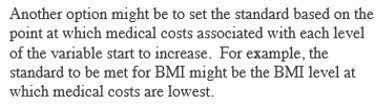
He claims that all these weigh-ins and fines will create an “insanely great program” for employees, whether they like it or not.
Vitality Group, Johnson & Johnson – and Ron Goetzel
Where would a wellness-related Hall of Shame be without Ron Goetzel? Name a debacle or scandal in wellness, and his fingerprints are on it. Penn State, Nebraska, McKesson, Bravo/Graco, and of course Wellsteps come immediately to mind.
He was also the very stable genius behind the Johnson & Johnson Fat Tax. The Fat Tax was supposed to be a game-changer, ostracizing overweight folks with the misfortune of working for publicly traded corporations. In this scheme, companies would weigh their employees and then disclose those weights to shareholders. The shareholders would presumably reward those companies doing the best job of reducing employee weight, creating more profit for the wellness vendors, like Vitality or Johnson & Johnson, who would help employees lose weight. Ultimately it would be a tax, in that every employer that did not hire a wellness company and/or fire fat employees would see its stock price tumble, making wellness a mandatory fee.
While this “fat tax” would go a long way towards achieving the Wellness Ignorati’s goal of monetizing body-shaming, bringing financial disclosure into the picture raises all sorts of regulatory issues. Could you force employees to be weighed in order to meet SEC disclosure rules? What if employees cheated on the weigh-in, as employees are wont to do? Would that create a Sarbanes-Oxley violation?
There are three ironies here. It turns out that companies that are obsessed with prying, poking and prodding their employees, like McKesson, watch their stock prices tumble. And companies specifically obsessed with goading their employees into crash-dieting contests, like Schlumberger’s chart below, have the worst stock performance of all.

Second, it turns out that Vitality can’t get its own employees to lose weight, and yet they want you to hire them to get your employees to lose weight.
Finally – and this shouldn’t come as a surprise to anyone – there is zero correlation between employee weight and corporate performance.
Mr. Goetzel works for Johns Hopkins and often places their name on his essays. If you have an opinion on whether Johns Hopkins should be supporting institutionalized body-shaming, you can express your opinion by writing to Dean Ellen MacKenzie at emacken1@jhu.edu .
Honorable mentions
Dr. Delos “Toby” Cosgrove, president of the Cleveland Clinic. After commenting that he would not hire smokers at the Clinic, he added that he would not hire obese people if he could legally deny them jobs.
So he doesn’t want to work with obese people, except if they happen to be president.
Dr. David Katz coined the term “oblivobesity” because apparently, he feels we have not yet made larger people feel bad enough about themselves to force them to do something about their weight – the difficulty of which has apparently been overstated because, according to Katz writing in the Huffington Post:
“There are rare cases of extreme weight loss resistance and such, but by and large, we can lose weight and find health by eating well and being active. Really.”
He deftly rebuts 30-plus years of consistent and conclusive research to the contrary by adding “really” to the end. Because everyone knows that makes a statement true. Really.
He also continues to illustrate his postings with pictures of headless fat people. And then there is his defense of Dr. Oz.
Please feel free to contact us about additional “shamers” you would like to add to the list along with the reasons why.
Share this:


Colon cancer screening should start at 45. (Not!)
If there is one thing the US healthcare system is really really good at, it’s rooting out hidden disease via massive hyperdiagnostic screening campaigns. But there is always room for “improvement” by finding some unsuspecting cohort — in this case, 45-year-olds — that was getting just a little too complacent about the fact that virtually no one that age dies of something that could have been found — and also prevented or addressed — via a non-USPSTF-recommended screen.
Serves them right.
The American Cancer Society (ACS) recently decided that, because the rate of colon cancer has been increasing in the 45-to-49-year old cohort, that screenings should start in that age group. The “alarming” 22% increase in relative risk during this century translates into an increase in the absolute rate of colon cancer in the 45-to-49 cohort from 0.035% to 0.043%. Yes–0.008% more of the 45-to-49 population in this country will get colon cancer now than 18 years ago. I’m surprised they didn’t recommend calling out the National Guard.
Further, many of that 0.035% experienced symptoms, and hence would be getting a colonoscopy as a diagnostic test, not a screen. And others in that age grouping had a family history and should get screened regardless of what the “average” person should do. Suppose those two categories account for half of the colon cancer population. That leaves roughly 0.018% of the 45-to-49-year-old population who could possibly benefit from a screen.
As with the other “alarming” colon cancer figures that have been published in the last few years, your chances of having your life saved by a colon cancer screening at that age is about the same as your chances of being struck by lightning.
And a screen is far from a lifesaver in general. Quite the contrary, statistically speaking it is likely to find the slow-growing tumors while missing the more aggressive, faster-growing tumors that begin between screens.
The Hazards of Screening
That trivial benefit must be weighed against the nontrivial harms. The risk of a complication, such as a perforation, is estimated between 1.6% and 1.8%. (In all fairness to the ACS, they aren’t insisting that the screen be done via a colonoscopy, though the non-invasive screens have such high positive/inconclusive test rates that they often lead to colonoscopies.)
Unless I have the decimal point in the wrong place, that means the rate of complications is a whopping 320 times the likelihood of something being found. Oh, wait a sec — make that 3200 times.
OF course, the worst complication is death, and the mortality rate from colonoscopies (0.02%) appears to be, on its face, much higher than the rate of lives that would be saved. However, once again, though it kills me to say it, in all fairness the mortality rate, and for that matter the complication rate, increases with advancing age, meaning the younger you are, the less likely you are to die from this screening. So maybe the mortality rate in the 45-50-year-old cohort isn’t any higher than — and might even be slightly lower than — the rate at which early detection will save lives. I feel much better knowing this. Don’t you?
And what is it about colon cancer that brings out people’s inner very stable genius? Here is the Cleveland Clinic on the subject:

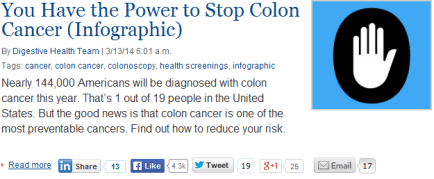
Newsflash: 144,000 is not “1 out of 19 people in the United States.” It is barely 1 out of 19 people in greater Cleveland.
The best argument against screening 45-year-olds
Nonetheless, when it comes to screening 45-year-olds for colon cancer, the best argument against it is that Star Wellness is for it. By way of background, Star Wellness is best known in wellness for not knowing anything about wellness. They take great pride in that, boasting that anyone can become a wellness vendor. All you need, they say, is a background in “sales or municipality administration,” five days of training…and of course a certified $65,000 check payable to — get ready — Star Wellness. No surprise that Star was leading the wellness industry’s race to the bottom until they got outstupided by Total Wellness, Interactive Health, and Wellsteps.
But Star Wellness is not willing to lose this race to the bottom without a fight.
Not content to offer the full range of USPSTF non-recommended screens, they are practically hyperventilating over this opportunity to add yet another one. They use the example of ovarian cancer screening to justify more colon screening. Here is the USPSTF on the subject of ovarian cancer screening:

The USPSTF found adequate evidence that screening for ovarian cancer can result in important harms, including many false-positive results, which can lead to unnecessary surgical interventions in women who do not have cancer. Depending on the type of screening test used, the magnitude of harm ranges from moderate to substantial and reflects the risk for unnecessary diagnostic surgery.
While we’re on the subject of Star Wellness…

Star, Vitamin B12 is not a vaccine.

And remind me why we are lining up employees to get Vitamin B-12 shots, vaccines or no vaccines?
While we’re on the subject of vaccines, according to the CDC, the biggest category of people who are supposed to get Hepatitis A/B vaccines include street drug users. If you are routinely hiring enough street drug users to be holding vaccination clinics focused on Hepatitis A/B, I’d say Vitamin B-12 deficiencies are not your biggest problem.
Share this:


These three minutes will make you an expert on the new EEOC rules
Rarely can you become an expert in something in 3 minutes but then again rarely is there a wellness vendor as cool as Wellable. Their 3-minute “Whiteboard Wednesday Wellness Minute” will show you how to make lemonade out of this EEOC lemon.

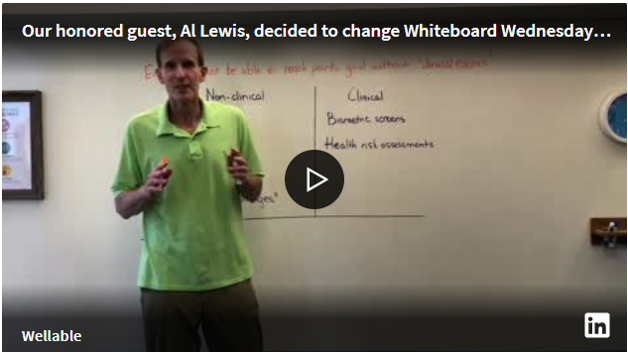
And you’ll see why it is so easy for Quizzify to indemnify the whole ball of EEOC wax


 They Said What?